Application
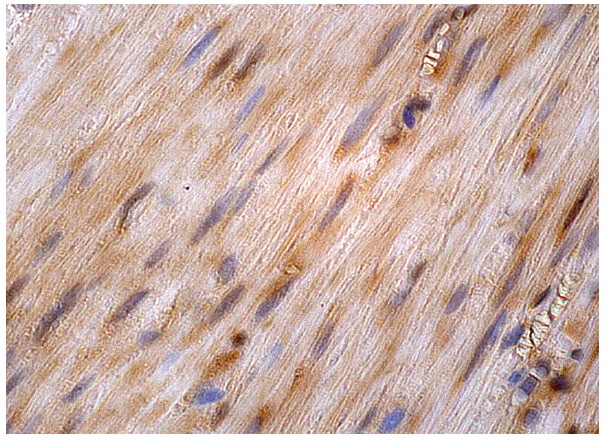
Immunoperoxidase staining of formalin fixed, paraffin-embedded human smooth muscle tissue showing cytoplasmic staining of smooth muscle cells.| Product Name | 12-LO Antibody (H-100) |
|---|---|
| Antibody Type | Primary Antibodies |
| Antigen Alias | epitope corresponding to amino acids 131-230 mapping within an internal region of 12-LO of human origin |
| Modification Notes | Lipoxygenases are a family of enzymes which dioxygenate unsaturated fatty acids, thus initiating lipoperoxidation of membranes, the synthesis of signalling molecules as well as inducing structural and metabolic changes in the cell. The Lox enzymes in mammals, 12-LO and 15-LO, are classified with respect to their positional specificity of the deoxygenation of their most common substrate, arachidonic acid. The metabolism of arachidonic acid leads to the generation of biologically active metabolites that have been implicated in cell growth and proliferation, as well as survival and apoptosis. The 12-LO pathway is a regulator of cell survival and apoptosis and affects the expression and localization of the Integrin aV/b5 and Actin microfilaments in rat Walker 256 carcinosarcoma cells. Platelet-type 12-LO regulates the growth and survival of a number of cancer cells. Human platelets metabolize arachidonic acid via 12-lipoxygenase to 12-hydroxyeicosatetraenoic acid. |
| Clonality | Polyclonal |
|---|---|
| Isotype | IgG |
| Host Species | Rabbit |
| Tested Applications | WBIPIFELISA |
| recommended for detection of 12-LO of mouse, rat and human origin by WB, IP, IF and ELISA also reactive with additional species, including equine and canine: |
|
| Species Reactivity | HumanMouseRat |
| Concentration | 1mg/ml |
| Purification | Affinity purified |
| Alternative Names | epitope corresponding to amino acids 131-230 mapping within an internal region of 12-LO of human origin |
|---|---|
| Tissue Specificity | epitope corresponding to amino acids 131-230 mapping within an internal region of 12-LO of human origin |
| Entrez Gene | 239 |
|---|
Application
Immunoperoxidase staining of formalin fixed, paraffin-embedded human smooth muscle tissue showing cytoplasmic staining of smooth muscle cells.| Application Notes | recommended for detection of 12-LO of mouse, rat and human origin by WB, IP, IF and ELISA also reactive with additional species, including equine and canine: |
|---|
| Form | Liquid |
|---|---|
| Storage Instructions | For short-term storage, store at 4° C. For long-term storage, aliquot and store at -20ºC or below. Avoid multiple freeze-thaw cycles. |
| Storage Buffer | phosphate buffered saline , pH 7.4, 150mM NaCl, 0.02% sodium azide and 50% glycerol. |


