Application
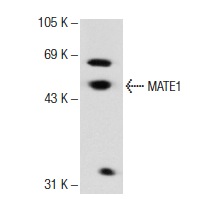
Western blot analysis of MATE1 expression in NCI-H1688 whole cell lysate.Application
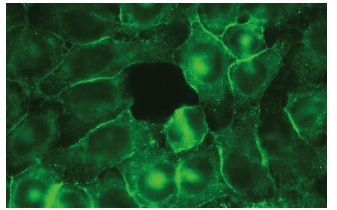
Immunofluorescence staining of methanol-fixed HeLa cells showing membrane localization.| Product Name | MATE1 Antibody (E-13) |
|---|---|
| Antibody Type | Primary Antibodies |
| Modification Notes | Transporters are expressed in a wide variety of tissues where they perform the critical function of enabling anionic and cationic chemicals of exogenous and endogenous origin to cross otherwise impermeable cell membranes. The multidrug and toxin extrusion (MATE) transporters mediate cellular efflux of a variety of organic cations, including many drugs, and are involved in excretion of toxic electrolytes through urine and bile. Members of the MATE family share homology with the bacterial MATE protein family, which is responsible for drug resistance. MATE1 (multidrug and toxin extrusion protein 1), also known as SLC47A1, is a 570 amino acid multi-pass membrane protein that predominantly localizes to the plasma membrane but is also found in intracellular organelles. Expressed in adrenal gland, and to a lower extent in liver, skeletal muscle and kidney, MATE1 is responsible for the secretion of cationic drugs across the brush border membranes. MATE1 exists as three isoforms, which are produced by alternative splicing events. |
| Clonality | Polyclonal |
|---|---|
| Isotype | IgG |
| Host Species | Rabbit |
| Tested Applications | WBIPIFELISA |
| recommended for detection of MATE1 of human origin by WB, IP, IF and ELISA non cross-reactive with MATE1-2 | |
| Species Reactivity | HumanMouseRat |
| Concentration | 1mg/ml |
| Purification | Affinity purified |
| Alternative Names | epitope mapping within a C-terminal cytoplasmic domain of MATE1 of human origin |
|---|---|
| Tissue Specificity | epitope mapping within a C-terminal cytoplasmic domain of MATE1 of human origin |
| Entrez Gene | 55244 |
|---|
Application
Western blot analysis of MATE1 expression in NCI-H1688 whole cell lysate.
Application
Immunofluorescence staining of methanol-fixed HeLa cells showing membrane localization.| Application Notes | recommended for detection of MATE1 of human origin by WB, IP, IF and ELISA non cross-reactive with MATE1-2 |
|---|
| Form | Liquid |
|---|---|
| Storage Instructions | For short-term storage, store at 4° C. For long-term storage, aliquot and store at -20ºC or below. Avoid multiple freeze-thaw cycles. |
| Storage Buffer | phosphate buffered saline , pH 7.4, 150mM NaCl, 0.02% sodium azide and 50% glycerol. |


