Application
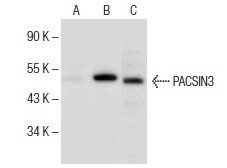
Western blot analysis of PACSIN3 expression in non-transfected 293T: (A), mouse PACSIN3 transfected 293T: (B) and HeLa (C) whole cell lysates.| Product Name | PACSIN3 Antibody (H-100) |
|---|---|
| Antibody Type | Primary Antibodies |
| Antigen Alias | epitope corresponding to amino acids 151-250 mapping within an internal region of PACSIN3 of human origin |
| Modification Notes | PACSINs are a family of cytoplasm-resisdent phosphoproteins that aid in vesicle formation and transport. It is presumed that all isoforms oligomerize and bind dynamin, synaptojanin 1 and N-WASP through their Src homology 3 domains. Furthermore, PACSINs colocalize with dynamin, but not with clathrin, indicating that the proteins may play a specific role with a defined population of dynamin at distinct cellular locations. PACSIN3 (Protein Kinase C and Casein Kinase Substrate in Neurons 3) contains a short proline-rich region and lacks asparagine-proline-phenylalanine motifs, which differentiates it from the rest of the PACSIN family. Sequence analysis of cDNAs encoding mouse and human PACSIN3 predict that the human protein consists of 424-amino acids and is 94% identical to the mouse protein. Studies of the mouse protein report predominant expression in mouse lung, skeletal muscle, and heart as well as in brain, kidney, and uterus. |
| Clonality | Polyclonal |
|---|---|
| Isotype | IgG |
| Host Species | Rabbit |
| Tested Applications | WBIPIFELISA |
| recommended for detection of PACSIN3 of mouse, rat and human origin by WB, IP, IF and ELISA also reactive with additional species, including equine, canine, bovine and porcine: |
|
| Species Reactivity | HumanMouseRat |
| Concentration | 1mg/ml |
| Purification | Affinity purified |
| Alternative Names | epitope corresponding to amino acids 151-250 mapping within an internal region of PACSIN3 of human origin |
|---|---|
| Tissue Specificity | epitope corresponding to amino acids 151-250 mapping within an internal region of PACSIN3 of human origin |
| Entrez Gene | 29763 |
|---|
Application
Western blot analysis of PACSIN3 expression in non-transfected 293T: (A), mouse PACSIN3 transfected 293T: (B) and HeLa (C) whole cell lysates.| Application Notes | recommended for detection of PACSIN3 of mouse, rat and human origin by WB, IP, IF and ELISA also reactive with additional species, including equine, canine, bovine and porcine: |
|---|
| Form | Liquid |
|---|---|
| Storage Instructions | For short-term storage, store at 4° C. For long-term storage, aliquot and store at -20ºC or below. Avoid multiple freeze-thaw cycles. |
| Storage Buffer | phosphate buffered saline , pH 7.4, 150mM NaCl, 0.02% sodium azide and 50% glycerol. |


