Application
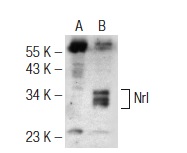
Western blot analysis of Nrl expression in non-transfected: (A) and human Nrl transfected: (B) 293T whole cell lysates.Application
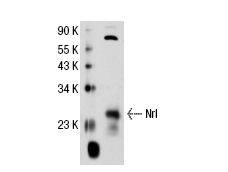
Western blot analysis of mouse Nrl expression in mouse eye tissue extract.| Product Name | Nrl Antibody (H-120) |
|---|---|
| Antibody Type | Primary Antibodies |
| Antigen Alias | epitope corresponding to amino acids 21-140 mapping within an internal region of Nrl of human origin |
| Modification Notes | Nrl (neural retina leucine zipper) is a member of the Maf family of transcription factors, which characteristically contain a highly conserved basic leucine zipper (bZIP)-DNA binding motif. Both Nrl and c-Maf preferentially bind to T-MARE sites and are implicated in a wide variety of developmental and physiologic roles. The Maf-Nrl subfamily regulates the expression of cell type-specific genes in tissues of the hematopoietic system, cerebellum and developing hindbrain. Maf and Nrl proteins bind an extended AP-1-like sequence and can form heterodimers with Fos and Jun transcription factors. In retinal cells and photoreceptor cells, Nrl promotes the expression of rhodopsin through binding to the Nrl response element present in the rhodopsin promoter. Nrl is expressed throughout the developing central and peripheral nervous system during neuronal differentiation, and its expression is restricted to neocortex, brainstem and retinal neurons during adulthood. |
| Clonality | Polyclonal |
|---|---|
| Isotype | IgG |
| Host Species | Rabbit |
| Tested Applications | WBIPIFELISAGSChIP |
| recommended for detection of Nrl of mouse, rat and human origin by WB, IP, IF and ELISA also reactive with additional species, including equine, canine, bovine and porcine: |
|
| Species Reactivity | HumanMouseRat |
| Concentration | 1mg/ml |
| Purification | Affinity purified |
| Alternative Names | epitope corresponding to amino acids 21-140 mapping within an internal region of Nrl of human origin |
|---|---|
| Tissue Specificity | epitope corresponding to amino acids 21-140 mapping within an internal region of Nrl of human origin |
| Entrez Gene | 4901 |
|---|
Application
Western blot analysis of Nrl expression in non-transfected: (A) and human Nrl transfected: (B) 293T whole cell lysates.
Application
Western blot analysis of mouse Nrl expression in mouse eye tissue extract.| Application Notes | recommended for detection of Nrl of mouse, rat and human origin by WB, IP, IF and ELISA also reactive with additional species, including equine, canine, bovine and porcine: |
|---|
| Form | Liquid |
|---|---|
| Storage Instructions | For short-term storage, store at 4° C. For long-term storage, aliquot and store at -20ºC or below. Avoid multiple freeze-thaw cycles. |
| Storage Buffer | phosphate buffered saline , pH 7.4, 150mM NaCl, 0.02% sodium azide and 50% glycerol. |


