Application
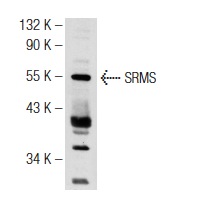
Western blot analysis of SRMS expression in MCF7 whole cell lysate.| Product Name | SRMS Antibody (H-143) |
|---|---|
| Antibody Type | Primary Antibodies |
| Modification Notes | Protein kinases comprise a large group of encoded factors that regulate cellular processes by catalyzing the transfer of a phosphate group to a hydroxyl acceptor in serine, threonine or tyrosine residues. SRMS (src-related kinase lacking C-terminal regulatory tyrosine and N-terminal myristylation sites), also known as SRM, is a 488 amino acid nonreceptor tyrosine-protein kinase that may play a role in the differentiation/proliferation of keratinocytes. SRMS consists of one Src homology 3 (SH3) domain, one Src homology 2 (SH2) domain and one protein kinase domain. The SH3 region is a small protein domain present in a large group of proteins, generally existing in association with catalytic domains. SH3 domains are also often accompanied by SH2 domains which bind to tyrosine-phosphorylated regions of target proteins, frequently linking activated growth factors to putative signal transduction proteins. Deletion or mutation of SH3 domains generally activate the transforming potential of nonreceptor tyrosine kinases, suggesting that SH3 mediates negative regulation of an intrinsic transforming activity. |
| Clonality | Polyclonal |
|---|---|
| Isotype | IgG |
| Host Species | Rabbit |
| Tested Applications | WBIPIFELISA |
| recommended for detection of SRMS of human origin by WB, IP, IF and ELISA | |
| Species Reactivity | HumanMouseRat |
| Concentration | 1mg/ml |
| Purification | Affinity purified |
| Alternative Names | epitope corresponding to amino acids 1-143 mapping at the N-terminus of SRMS of human origin |
|---|---|
| Tissue Specificity | epitope corresponding to amino acids 1-143 mapping at the N-terminus of SRMS of human origin |
| Entrez Gene | 6725 |
|---|
Application
Western blot analysis of SRMS expression in MCF7 whole cell lysate.| Application Notes | recommended for detection of SRMS of human origin by WB, IP, IF and ELISA |
|---|
| Form | Liquid |
|---|---|
| Storage Instructions | For short-term storage, store at 4° C. For long-term storage, aliquot and store at -20ºC or below. Avoid multiple freeze-thaw cycles. |
| Storage Buffer | phosphate buffered saline , pH 7.4, 150mM NaCl, 0.02% sodium azide and 50% glycerol. |


