Application
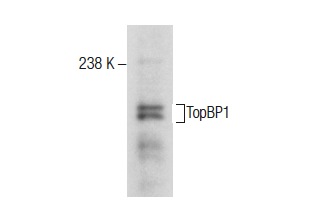
Western blot analysis of TopBP1 expression in Jurkat nuclear extract.| Product Name | TopBP1 Antibody (H-300) |
|---|---|
| Antibody Type | Primary Antibodies |
| Modification Notes | Human DNA topoisomerase II binding protein 1 (TopBP1) contains eight BRCT motifs that are found in proteins regulating the DNA damage response, transcription, and replication (1). In addition, TopBP1 shares sequence similarity with the fission yeast Rad4/Cut5 protein and the budding yeast DPB11 protein, both of which are required for DNA damage control and/or replication checkpoint control (2,3). Phosphorylation of TopBP1 occurs in response to DNA double-strand breaks and replication blocks (2). TopBP1 forms nuclear foci and localizes to the sites of DNA damage or the arrested replication forks (2,3). Downregulation of TopBP1 leads to reduced cell survival, probably due to increased apoptosis (2). TopBP1 functions as a transcriptional coactivator by enhancing the human papillomavirus (HPV) transcription/replication factor E2 (1). In addition, the HECT-domain ubiquitin ligase, hHYD, cooperates with TopBP1 in DNA damage response (4). TopBP1 specifically interacts with the C-terminal region of topoisomerase II beta, which suggests a supportive role for TopBP1 in the catalytic reactions of topoisomerase II beta through transient breakages of DNA strands (5). The gene encoding TopBP1 maps to chromosome 3q22.2 (5). |
| Clonality | Polyclonal |
|---|---|
| Isotype | IgG |
| Host Species | Rabbit |
| Tested Applications | WBIPIFELISA |
| recommended for detection of TopBP1 of mouse, rat and human origin by WB, IP, IF and ELISA also reactive with additional species, including equine, canine, bovine and porcine | |
| Species Reactivity | HumanMouseRat |
| Concentration | 1mg/ml |
| Purification | Affinity purified |
| Alternative Names | epitope corresponding to amino acids 1136-1435 mapping at the C-terminus of TopBP1 of human origin |
|---|---|
| Tissue Specificity | epitope corresponding to amino acids 1136-1435 mapping at the C-terminus of TopBP1 of human origin |
| Entrez Gene | 11073 |
|---|
Application
Western blot analysis of TopBP1 expression in Jurkat nuclear extract.| Application Notes | recommended for detection of TopBP1 of mouse, rat and human origin by WB, IP, IF and ELISA also reactive with additional species, including equine, canine, bovine and porcine |
|---|
| Form | Liquid |
|---|---|
| Storage Instructions | For short-term storage, store at 4° C. For long-term storage, aliquot and store at -20ºC or below. Avoid multiple freeze-thaw cycles. |
| Storage Buffer | phosphate buffered saline , pH 7.4, 150mM NaCl, 0.02% sodium azide and 50% glycerol. |


