Application
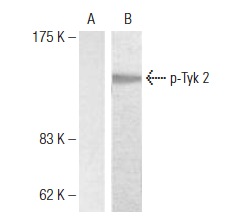
Western blot analysis of phosphorylated Tyk 2 expression in untreated (A) and Anisomycin-treated (B) HT-29 cell extracts.| Product Name | p-Tyk 2 Antibody (Tyr 1054) |
|---|---|
| Antibody Type | Primary Antibodies |
| Antigen Alias | raised against a short amino acid sequence containing phosphorylated Tyr 1054 of Tyk 2 of human origin |
| Modification | Phosphoralated |
| Modification Notes | Members of the Janus family of tyrosine kinases, including JAK1, JAK2 and Tyk 2, are characterized by the presence of a second kinase domain and the absence of SH2, SH3 and membrane spanning domains. The members of this family of tyrosine kinases play a critical role in coupling ligand binding of cytokine receptors to tyrosine phosphorylation. For instance, Tyk 2 couples IFNa/b binding to tyrosine phosphorylation of the proteins of the IFN-stimulated gene factor 3 complex. The Tyk and Jak family is involved in signal transduction in response to a specific family of cytokines, which consists of ciliary neurotrophic factor (CNTF), leukemia inhibitory factor (LIF), oncostatin M (OSM), and interleukin-6 (IL-6). Tyk 2 is subject to intermolecular tyrosine phosphorylation after homodimer formation. Human and mouse Tyk 2 are phosphorylated on Tyr 1054, leading Tyk 2 activation. |
| Clonality | Polyclonal |
|---|---|
| Isotype | IgG |
| Host Species | Rabbit |
| Tested Applications | WBIP |
| recommended for detection of Tyr 1054 phosphorylated Tyk 2 of human origin and correspondingly phosphorylated Tyr 1047 of mouse origin of mouse and human origin by WB and IP: |
|
| Species Reactivity | HumanMouseRat |
| Concentration | 1mg/ml |
| Purification | Affinity purified |
| Alternative Names | raised against a short amino acid sequence containing phosphorylated Tyr 1054 of Tyk 2 of human origin |
|---|---|
| Tissue Specificity | raised against a short amino acid sequence containing phosphorylated Tyr 1054 of Tyk 2 of human origin |
| Entrez Gene | 7297 |
|---|
Application
Western blot analysis of phosphorylated Tyk 2 expression in untreated (A) and Anisomycin-treated (B) HT-29 cell extracts.| Application Notes | recommended for detection of Tyr 1054 phosphorylated Tyk 2 of human origin and correspondingly phosphorylated Tyr 1047 of mouse origin of mouse and human origin by WB and IP: |
|---|
| Form | Liquid |
|---|---|
| Storage Instructions | For short-term storage, store at 4° C. For long-term storage, aliquot and store at -20ºC or below. Avoid multiple freeze-thaw cycles. |
| Storage Buffer | phosphate buffered saline , pH 7.4, 150mM NaCl, 0.02% sodium azide and 50% glycerol. |


