Application
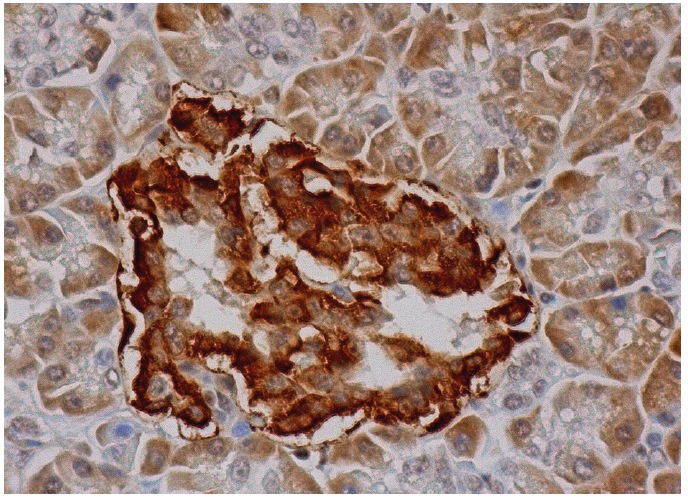
Immunoperoxidase staining of formalin fixed, paraffin-embedded human pancreas tissue showing cytoplasmic staining of exocrine glandular cells and cytoplasmic and membrane staining of Islets of Langerhans.| Product Name | TATI Antibody (FL-79) |
|---|---|
| Antibody Type | Primary Antibodies |
| Antigen Alias | epitope corresponding to amino acids 1-72 mapping at the N-terminus of TATI of human origin |
| Modification Notes | Tumor-associated trypsin inhibitor (TATI), also designated Pancreatic secretory trypsin inhibitor, contains one Kazal-like domain. It is a secreted trypsin inhibitor preventing trypsin-catalyzed premature activation of zymogens in the pancreas. The gene encoding for this 79 amino acid protein, named SPINK1, localizes to chromosome 5q32. Defects in this gene are the cause of chronic pancreatitis (CP), an autosomal dominant disease causing severe abdominal pain attacks. CP is characterized by calculi in pancreatic ducts. TATI can be found in the cyst fluid of cystic pancreatic lesion patients and is a potential marker for differentiating between the diagnosis of benign cystic pancreatic lesions and malignant cystic pancreatic lesions. |
| Clonality | Polyclonal |
|---|---|
| Isotype | IgG |
| Host Species | Rabbit |
| Tested Applications | WBIPIFELISA |
| recommended for detection of TATI of human origin by WB, IP, IF and ELISA: |
|
| Species Reactivity | HumanMouseRat |
| Concentration | 1mg/ml |
| Purification | Affinity purified |
| Alternative Names | epitope corresponding to amino acids 1-72 mapping at the N-terminus of TATI of human origin |
|---|---|
| Tissue Specificity | epitope corresponding to amino acids 1-72 mapping at the N-terminus of TATI of human origin |
| Entrez Gene | 6690 |
|---|
Application
Immunoperoxidase staining of formalin fixed, paraffin-embedded human pancreas tissue showing cytoplasmic staining of exocrine glandular cells and cytoplasmic and membrane staining of Islets of Langerhans.| Application Notes | recommended for detection of TATI of human origin by WB, IP, IF and ELISA: |
|---|
| Form | Liquid |
|---|---|
| Storage Instructions | For short-term storage, store at 4° C. For long-term storage, aliquot and store at -20ºC or below. Avoid multiple freeze-thaw cycles. |
| Storage Buffer | phosphate buffered saline , pH 7.4, 150mM NaCl, 0.02% sodium azide and 50% glycerol. |


