Application
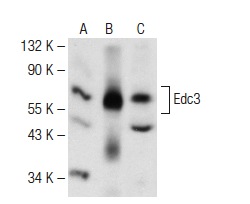
Western blot analysis of Edc3 expression in non-transfected 293: (A), human Edc3 transfected 293: (B) and 3T3-L1 (C) whole cell lysates.| Product Name | Edc3 Antibody (H-300) |
|---|---|
| Antibody Type | Primary Antibodies |
| Antigen Alias | epitope corresponding to amino acids 209-508 mapping at the C-terminus of Edc3 of human origin |
| Modification Notes | The major eukaryotic mRNA decay pathway occurs through deadenylation, decapping, and 5' to 3' degradation of the mRNA. Decapping is a critical control point in this decay pathway. During the process of mRNA degradation, Edc3 has been found to play a role in mRNA decapping. As part of the mRNA degradation process, Edc3 becomes part of a complex that also contains hDcp1a, hDcp2a, RCK and Edc4/HEDLS. Within this complex, Edc3 directly interacts with DCP1A and DDX6. Edc3, enhancer of mRNA-decapping protein 3, is a 508 amino acid protein that maps to human gene EDC3. Edc3 is a member of the EDC3 family and contains one YjeF N-terminal domain. Edc3 is localized to the cytoplasm and is found primarily in the processing bodies (PBs) of the cell. Evidence indicates Edc3 also interacts with TTP (zinc finger protein 36), a candidate gene for obesity-related metabolic complications. |
| Clonality | Polyclonal |
|---|---|
| Isotype | IgG |
| Host Species | Rabbit |
| Tested Applications | WBIPIFELISA |
| recommended for detection of Edc3 of mouse, rat and human origin by WB, IP, IF and ELISA also reactive with additional species, including equine, canine, porcine and avian: |
|
| Species Reactivity | HumanMouseRat |
| Concentration | 1mg/ml |
| Purification | Affinity purified |
| Alternative Names | epitope corresponding to amino acids 209-508 mapping at the C-terminus of Edc3 of human origin |
|---|---|
| Tissue Specificity | epitope corresponding to amino acids 209-508 mapping at the C-terminus of Edc3 of human origin |
| Entrez Gene | 80153 |
|---|
Application
Western blot analysis of Edc3 expression in non-transfected 293: (A), human Edc3 transfected 293: (B) and 3T3-L1 (C) whole cell lysates.| Application Notes | recommended for detection of Edc3 of mouse, rat and human origin by WB, IP, IF and ELISA also reactive with additional species, including equine, canine, porcine and avian: |
|---|
| Form | Liquid |
|---|---|
| Storage Instructions | For short-term storage, store at 4° C. For long-term storage, aliquot and store at -20ºC or below. Avoid multiple freeze-thaw cycles. |
| Storage Buffer | phosphate buffered saline , pH 7.4, 150mM NaCl, 0.02% sodium azide and 50% glycerol. |


