Application
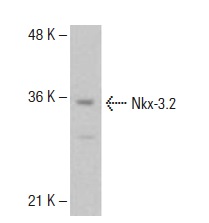
Western blot analysis of Nkx-3.2 expression in Jurkat whole cell lysate.| Product Name | Nkx-3.2 Antibody (O-24) |
|---|---|
| Antibody Type | Primary Antibodies |
| Antigen Alias | recommended for detection of Nkx-3.2 of mouse and human origin by WB, IP and ELISA; also reactive with additional species, including canine |
| Modification Notes | The homeobox gene Nkx-3.2, also designated Bapx1, is the human homolog of Drosophila bagpipe, which, in conjunction with tinman, determines cell fate in the dorsal mesoderm. In mammalian species, Nkx-3.2 is a key transcription factor that regulates the development of smooth muscle tissues and skeletal structures. Specifically, Nkx-3.2 regulates spleen development and the development of the axial skeleton. It is also considered as an early marker for prechondrogenic cells. The human Nkx-3.2 gene maps to chromosome 4p16.1, a region containing loci for several skeletal diseases. Nkx-3.2 null mice exhibit skeletal dysplasia, asplenia, and gastroduodenal malformation, with abnormal development of the vertebral column and cranial bones of mesodermal origin. During axial cartilage formation, Nkx-3.2 inhibits the actions of Shh, a factor that interferes with the prochondrogenic effects of the BMPs. |
| Clonality | Polyclonal |
|---|---|
| Isotype | IgG |
| Host Species | Rabbit |
| Tested Applications | WBIPELISA |
| WB:1:500~1:2000 IP:1:100~1:500 Notes:Optimal dilutions/concentrations should be determined by the researcher. |
|
| Species Reactivity | HumanMouseRat |
| Concentration | 1mg/ml |
| Purification | Affinity purified |
| Alternative Names | recommended for detection of Nkx-3.2 of mouse and human origin by WB IP and ELISA also reactive with additional species including canine |
|---|---|
| Tissue Specificity | recommended for detection of Nkx-3.2 of mouse and human origin by WB, IP and ELISA; also reactive with additional species, including canine |
| Entrez Gene | 579 |
|---|
Application
Western blot analysis of Nkx-3.2 expression in Jurkat whole cell lysate.| Application Notes | WB:1:500~1:2000 IP:1:100~1:500 Notes:Optimal dilutions/concentrations should be determined by the researcher. |
|---|
| Form | Liquid |
|---|---|
| Storage Instructions | For short-term storage, store at 4° C. For long-term storage, aliquot and store at -20ºC or below. Avoid multiple freeze-thaw cycles. |
| Storage Buffer | phosphate buffered saline , pH 7.4, 150mM NaCl, 0.02% sodium azide and 50% glycerol. |


