Application
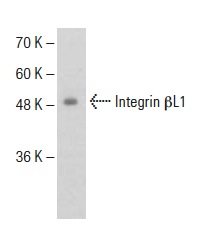
Western blot analysis of Integrin βL1 expression in Jurkat whole cell lysate.| Product Name | Integrin βL1 Antibody (F-21) |
|---|---|
| Antibody Type | Primary Antibodies |
| Antigen Alias | recommended for detection of Integrin βL1 of human origin by WB, IP and ELISA; also reactive with additional species, including canine |
| Modification Notes | Most integrin receptors bind ligands that are components of the extracellular matrix, including fibronectin, collagen and vitronectin. Certain integrins can also bind to soluble ligands, such as fibrinogen, or to counterreceptors on adjacent cells such as the intracellular adhesion molecules (ICAMs), leading to aggregation of cells. Ligands serve to cross-link or cluster integrins by binding to adjacent integrin receptors; both receptor clustering and ligand occupancy are necessary for the activation of integrin-mediated responses. In addition to mediating cell adhesion and cytoskeletal organization, integrins function as signaling receptors. Signals transduced by integrins play a role in many biological processes, including cell growth, differentiation, migration and apoptosis. Integrin ∫L1 (integrin, beta-like 1), also known as OSCP (osteoblast-specific cysteine-rich protein), TIED (ten integrin EGF-like repeat domain-containing protein) or ITGBL1, is a 494 amino acid secreted protein that is widely expressed in many tissues, but readily detectable only in aorta. Integrin ∫L1 contains ten tandem EGF-like repeats that are similar to those found in the cysteine rich 'stalk-like' structure of integrin beta-subunits. |
| Clonality | Polyclonal |
|---|---|
| Isotype | IgG |
| Host Species | Rabbit |
| Tested Applications | WBIPELISA |
| WB:1:500~1:2000 IP:1:100~1:500 Notes:Optimal dilutions/concentrations should be determined by the researcher. |
|
| Species Reactivity | HumanMouseRat |
| Concentration | 1mg/ml |
| Purification | Affinity purified |
| Alternative Names | recommended for detection of Integrin &beta L1 of human origin by WB IP and ELISA also reactive with additional species including canine |
|---|---|
| Tissue Specificity | recommended for detection of Integrin βL1 of human origin by WB, IP and ELISA; also reactive with additional species, including canine |
| Entrez Gene | 9358 |
|---|
Application
Western blot analysis of Integrin βL1 expression in Jurkat whole cell lysate.| Application Notes | WB:1:500~1:2000 IP:1:100~1:500 Notes:Optimal dilutions/concentrations should be determined by the researcher. |
|---|
| Form | Liquid |
|---|---|
| Storage Instructions | For short-term storage, store at 4° C. For long-term storage, aliquot and store at -20ºC or below. Avoid multiple freeze-thaw cycles. |
| Storage Buffer | phosphate buffered saline , pH 7.4, 150mM NaCl, 0.02% sodium azide and 50% glycerol. |


