Application
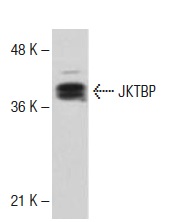
Western blot analysis of JKTBP expression in Daudi whole cell lysate.| Product Name | JKTBP Antibody (G-24) |
|---|---|
| Antibody Type | Primary Antibodies |
| Antigen Alias | recommended for detection of JKTBP of mouse and human origin by WB, IP and ELISA; also reactive with additional species, including canine |
| Modification Notes | Heterogeneous nuclear ribonucleoproteins (hnRNPs) constitute a set of polypeptides that contribute to mRNA transcription and pre-mRNA processing, as well as mature mRNA transport to the cytoplasm and translation. There are approximately 20 known hnRNP proteins, and their complexes are the major constituents of the spliceosome. The majority of hnRNP protein components are localized to the nucleus, however some shuttle between the nucleus and the cytoplasm. JKTBP (JKT41-binding protein), also known as HNRPDL (heterogeneous nuclear ribonucleoprotein D-like), is a 420 amino acid hnRNP that shuttles between the nucleus and the cytoplasm and contains two RRM (RNA recognition motif) domains. Expressed in a variety of tissues, including liver, brain, lung, placenta, kidney, spleen, testis, thymus, ovary and skeletal muscle, JKTBP functions as a transcriptional regulator that binds to both single- and double-stranded DNA and is capable of both enhancing and repressing transcriptional activity. Multiple isoforms of JKTBP exist due to alternative splicing events. |
| Clonality | Polyclonal |
|---|---|
| Isotype | IgG |
| Host Species | Rabbit |
| Tested Applications | WBIPELISA |
| WB:1:500~1:2000 IP:1:100~1:500 Notes:Optimal dilutions/concentrations should be determined by the researcher. |
|
| Species Reactivity | HumanMouseRat |
| Concentration | 1mg/ml |
| Purification | Affinity purified |
| Alternative Names | recommended for detection of JKTBP of mouse and human origin by WB IP and ELISA also reactive with additional species including canine |
|---|---|
| Tissue Specificity | recommended for detection of JKTBP of mouse and human origin by WB, IP and ELISA; also reactive with additional species, including canine |
| Entrez Gene | 9987 |
|---|
Application
Western blot analysis of JKTBP expression in Daudi whole cell lysate.| Application Notes | WB:1:500~1:2000 IP:1:100~1:500 Notes:Optimal dilutions/concentrations should be determined by the researcher. |
|---|
| Form | Liquid |
|---|---|
| Storage Instructions | For short-term storage, store at 4° C. For long-term storage, aliquot and store at -20ºC or below. Avoid multiple freeze-thaw cycles. |
| Storage Buffer | phosphate buffered saline , pH 7.4, 150mM NaCl, 0.02% sodium azide and 50% glycerol. |


