Application
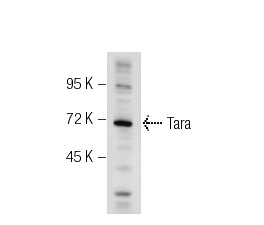
Western blot analysis of Tara expression in HeLa whole cell lysate.| Product Name | Tara Antibody (S-13) |
|---|---|
| Antibody Type | Primary Antibodies |
| Antigen Alias | epitope mapping within an internal region of Tara of human origin |
| Modification Notes | Tara (Trio-associated repeat on actin), also known as TRIOBP (TRIO and F-actin-binding protein) or DFNB28, is a widely expressed protein with highest levels of expression in heart and placenta. Tara localizes to the nucleus and cytoplasm. It contains a pleckstrin homology domain at the N-terminus and a coiled-coil region at the C-terminus. Tara binds to and interacts with Trio, TRF1 and F-actin. Via these interactions, Tara plays a role in the development of neural tissue and the organization of the actin cytoskeleton. Tara functions to stabilize F-actin structures and therefore is also involved in the control of cell growth and motility. Mutations in the gene encoding this protein may result in autosomal recessive nonsyndromic sensorineural deafness type 28 (DFNB28). Five isoforms exist for Tara due to alternative splicing. Isoform 3, also known as the long isoform, is exclusively expressed in fetal retina, cochlea and brain. |
| Clonality | Polyclonal |
|---|---|
| Isotype | IgG |
| Host Species | Rabbit |
| Tested Applications | WBIPIFELISA |
| recommended for detection of Tara of mouse, rat and human origin by WB, IP, IF and ELISA non cross-reactive with Tara-5: |
|
| Species Reactivity | HumanMouseRat |
| Concentration | 1mg/ml |
| Purification | Affinity purified |
| Alternative Names | epitope mapping within an internal region of Tara of human origin |
|---|---|
| Tissue Specificity | epitope mapping within an internal region of Tara of human origin |
| Entrez Gene | 11078 |
|---|
Application
Western blot analysis of Tara expression in HeLa whole cell lysate.| Application Notes | recommended for detection of Tara of mouse, rat and human origin by WB, IP, IF and ELISA non cross-reactive with Tara-5: |
|---|
| Form | Liquid |
|---|---|
| Storage Instructions | For short-term storage, store at 4° C. For long-term storage, aliquot and store at -20ºC or below. Avoid multiple freeze-thaw cycles. |
| Storage Buffer | phosphate buffered saline , pH 7.4, 150mM NaCl, 0.02% sodium azide and 50% glycerol. |


