Application
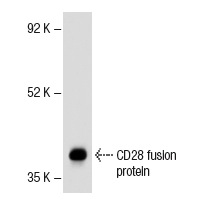
Western blot analysis of human recombinant CD28 fusion protein.| Product Name | CD28 Antibody (H-93) |
|---|---|
| Antibody Type | Primary Antibodies |
| Antigen Alias | epitope corresponding to amino acids 19-111 of CD28 of human origin |
| Modification Notes | T cell proliferation and lymphokine production are triggered by occupation of the TCR by antigen, followed by a costimulatory signal that is delivered by a ligand expressed on antigen presenting cells (1,2). The B7-related cell surface proteins CD80 (B7-1) and CD86 (B7-2) are expressed on antigen presenting cells, bind the homologous T cell receptors CD28 and CTLA-4 (cytotoxic T lymphocyte-associated protein-4) and trigger costimulatory signals for optimal T cell activation (3,4). CTLA-4 shares 31% overall amino acid identity with CD28, and it has been proposed that CD28 and CTLA-4 are functionally redundant (5). SLAM is a novel receptor on T cells that, when engaged, potentiates T cell expansion in a CD28-independent manner (6). B7, also designated BB1, is another ligand or counterreceptor for CD28 and CTLA-4 that is expressed on the antigen-presenting cell (1,7). |
| Clonality | Polyclonal |
|---|---|
| Isotype | IgG |
| Host Species | Rabbit |
| Tested Applications | WBIPIFELISA |
| recommended for detection of CD28 of mouse, rat and human origin by WB, IP, IF and ELISA: |
|
| Species Reactivity | HumanMouseRat |
| Concentration | 1mg/ml |
| Purification | Affinity purified |
| Alternative Names | epitope corresponding to amino acids 19-111 of CD28 of human origin |
|---|---|
| Tissue Specificity | epitope corresponding to amino acids 19-111 of CD28 of human origin |
| Entrez Gene | 940 |
|---|
Application
Western blot analysis of human recombinant CD28 fusion protein.| Application Notes | recommended for detection of CD28 of mouse, rat and human origin by WB, IP, IF and ELISA: |
|---|
| Form | Liquid |
|---|---|
| Storage Instructions | For short-term storage, store at 4° C. For long-term storage, aliquot and store at -20ºC or below. Avoid multiple freeze-thaw cycles. |
| Storage Buffer | phosphate buffered saline , pH 7.4, 150mM NaCl, 0.02% sodium azide and 50% glycerol. |


