Application
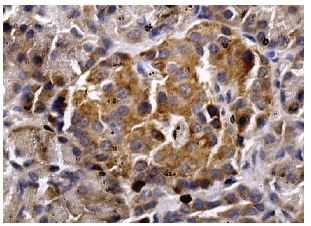
Immunoperoxidase staining of formalin fixed, paraffin-embedded human pancreas tissue showing cytoplasmic staining of Islets of Langerhans and glandular cells.| Product Name | RIG-I Antibody (H-300) |
|---|---|
| Antibody Type | Primary Antibodies |
| Antigen Alias | epitope corresponding to amino acids 1-281 mapping at the N-terminus of RIG-I of human origin |
| Modification Notes | The innate immune system senses viral infection by recognizing many different viral components and triggering specific antiviral responses. Intracellular double-stranded RNA (dsRNA) is a major sign of replication for many viruses. Retinoic acid inducible gene I (RIG-I) is a 925 amino acid, interferon-inducible cellular DExD/H box RNA helicase that activates type I interferon (IFN), an important effector of the innate immune system that is sensitive to these dsRNA viruses. dsRNA is normally present in very low quantities in cells, so when a virus is present, the elevated levels of dsRNA act as a sign telling RIG-I to activate the production of IFN. RIG-I does this by using its helicase domain to bind to viral dsRNA, thus transmitting the activation signal for IFN through IkB kinase-related kinases and inducing IFN expression. RIG-I is expressed in the cytoplasm of fibroblasts and conventional dendritic cells and can distinguish between many different RNA viruses. |
| Clonality | Polyclonal |
|---|---|
| Isotype | IgG |
| Host Species | Rabbit |
| Tested Applications | WBIPIFIHCELISA |
| recommended for detection of RIG-I of human and, to a lesser extent, mouse and rat origin by WB, IP, IF, IHC(P) and ELISA: |
|
| Species Reactivity | HumanMouseRat |
| Concentration | 1mg/ml |
| Purification | Affinity purified |
| Alternative Names | epitope corresponding to amino acids 1-281 mapping at the N-terminus of RIG-I of human origin |
|---|---|
| Tissue Specificity | epitope corresponding to amino acids 1-281 mapping at the N-terminus of RIG-I of human origin |
| Entrez Gene | 23586 |
|---|
Application
Immunoperoxidase staining of formalin fixed, paraffin-embedded human pancreas tissue showing cytoplasmic staining of Islets of Langerhans and glandular cells.| Application Notes | recommended for detection of RIG-I of human and, to a lesser extent, mouse and rat origin by WB, IP, IF, IHC(P) and ELISA: |
|---|
| Form | Liquid |
|---|---|
| Storage Instructions | For short-term storage, store at 4° C. For long-term storage, aliquot and store at -20ºC or below. Avoid multiple freeze-thaw cycles. |
| Storage Buffer | phosphate buffered saline , pH 7.4, 150mM NaCl, 0.02% sodium azide and 50% glycerol. |


