Application
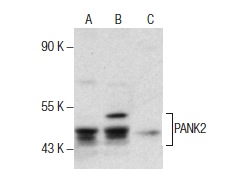
Western blot analysis of PANK2 expression in An3 CA (A) and HeLa (B) whole cell lysates and human liver tissue extract (C).| Product Name | PANK2 Antibody (E-17) |
|---|---|
| Antibody Type | Primary Antibodies |
| Antigen Alias | epitope mapping within an internal region of PANK2 of human origin |
| Modification Notes | PANK2 (pantothenate kinase 2), also known as HSS, HARP, PKAN or NBIA1, is a ubiquitously expressed 570 amino acid member of the pantothenate kinase family of enzymes that are involved in the synthesis of coenzyme A (CoA). Localized to the cytoplasm and mitochondria, PANK2 is thought to be the chief regulator of CoA biosynthesis, catalyzing the first of five steps in the biosynthetic pathway. Regulated by feedback inhibition from synthesized CoA, PANK2 catalyzes the ATP-dependent conversion of pantothenate to 4’-phosphopantothenate, thus initiating the first committed step in CoA biosynthesis. Defects in the gene encoding PANK2 are the cause of pantothenate kinase-associated neurodegeneration (PKAN) and hypoprebetalipoproteinemia, acanthocytosis, retinitis pigmentosa and pallidal degeneration (HARP). PKAN and HARP are rare disorders characterized by extrapyramidal dysfunction and progressive dementia, both of which are caused by an accumulation of iron in the brain. PANK2 is expressed as three isoforms due to alternative splicing events. |
| Clonality | Polyclonal |
|---|---|
| Isotype | IgG |
| Host Species | Rabbit |
| Tested Applications | WBIPIFELISA |
| recommended for detection of PANK2 of human origin by WB, IP, IF and ELISA non cross-reactive with isoform PANK2-2: |
|
| Species Reactivity | HumanMouseRat |
| Concentration | 1mg/ml |
| Purification | Affinity purified |
| Alternative Names | epitope mapping within an internal region of PANK2 of human origin |
|---|---|
| Tissue Specificity | epitope mapping within an internal region of PANK2 of human origin |
| Entrez Gene | 80025 |
|---|
Application
Western blot analysis of PANK2 expression in An3 CA (A) and HeLa (B) whole cell lysates and human liver tissue extract (C).| Application Notes | recommended for detection of PANK2 of human origin by WB, IP, IF and ELISA non cross-reactive with isoform PANK2-2: |
|---|
| Form | Liquid |
|---|---|
| Storage Instructions | For short-term storage, store at 4° C. For long-term storage, aliquot and store at -20ºC or below. Avoid multiple freeze-thaw cycles. |
| Storage Buffer | phosphate buffered saline , pH 7.4, 150mM NaCl, 0.02% sodium azide and 50% glycerol. |


