Application
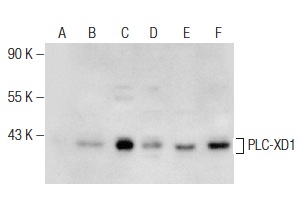
Western blot analysis of PLC-XD1 expression in non-transfected 293T: (A), human PLC-XD1 transfected 293T: (B), An3 CA (C), K-562 (D), T-47D (E) and T-47D (F) whole cell lysates.| Product Name | PLC-XD1 Antibody (S-15) |
|---|---|
| Antibody Type | Primary Antibodies |
| Antigen Alias | epitope mapping within an internal region of PLC-XD1 of human origin |
| Modification Notes | PLC-XD1 (PI-PLC X domain-containing protein 1) is a 323 amino acid enzyme that contains a phosphatidylinositol-specific phospholipase C X domain, which seems to be responsible for its catalytic activity. The gene encoding PLC-XD1 is located in the psuedoautosomal region 1 (PAR1) of X and Y chromosomes, therefore it is most likely inherited as an autosomal gene rather than in a sex-linked fashion. Recombination between psuedoautosomal regions is necessary for the progression of normal spermatogenesis, therefore disruptions of this process may lead to disorders such as male infertility or certain anueploidy conditions. There are two human homologs of psuedoautosomal regions, PAR1 and PAR2. PAR1 is located at the tips of the short arms while PAR2 is located at the tips of the long arms. PAR1 has been shown to contain several active genes, all of which escape X inactivation. It is thought that these regions are remnants of rearrangement and degradation of the ancestral Y chromosome. |
| Clonality | Polyclonal |
|---|---|
| Isotype | IgG |
| Host Species | Rabbit |
| Tested Applications | WBIPIFELISA |
| recommended for detection of PLC-XD1 of mouse, rat and human origin by WB, IP, IF and ELISA also reactive with additional species, including equine, canine, bovine and avian: |
|
| Species Reactivity | HumanMouseRat |
| Concentration | 1mg/ml |
| Purification | Affinity purified |
| Alternative Names | epitope mapping within an internal region of PLC-XD1 of human origin |
|---|---|
| Tissue Specificity | epitope mapping within an internal region of PLC-XD1 of human origin |
| Entrez Gene | 55344 |
|---|
Application
Western blot analysis of PLC-XD1 expression in non-transfected 293T: (A), human PLC-XD1 transfected 293T: (B), An3 CA (C), K-562 (D), T-47D (E) and T-47D (F) whole cell lysates.| Application Notes | recommended for detection of PLC-XD1 of mouse, rat and human origin by WB, IP, IF and ELISA also reactive with additional species, including equine, canine, bovine and avian: |
|---|
| Form | Liquid |
|---|---|
| Storage Instructions | For short-term storage, store at 4° C. For long-term storage, aliquot and store at -20ºC or below. Avoid multiple freeze-thaw cycles. |
| Storage Buffer | phosphate buffered saline , pH 7.4, 150mM NaCl, 0.02% sodium azide and 50% glycerol. |


