Application
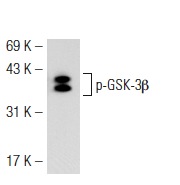
Western blot analysis of GSK-3β phosphorylation in A-431 whole cell lysate.| Product Name | p-GSK-3β Antibody (Ser 21) |
|---|---|
| Antibody Type | Primary Antibodies |
| Antigen Alias | recommended for detection of Ser 21 phosphorylated GSK-3β of human origin by WB, IP and ELISA |
| Modification | Phosphoralated |
| Modification Notes | Glycogen synthase kinase-3å (GSK-3å) and GSK-3∫ are highly similar isoforms of serine/ threonine kinases that regulate metabolic enzymes and transcription factors, which are responsible for coordinating processes such as glycogen synthesis and cell adhesion. GSK-3∫ activity is also required for nuclear activity of Rel dimers, which mediate an anti-apoptotic response to TNFå in mice. GSK-3 catalytic kinase activity is controlled through differential phosphorylation of serine/threonine residues, which have an inhibitory effect, and tyrosine residues, which have an activating effect. Growth factor stimulation of mammalian cells expressing GSK-3å and GSK-3∫ induces phosphorylation of Ser 21 and Ser 9, respectively, through a phosphatidylinositol 3-kinase (PI 3-K)-protein kinase B (PKB)-dependent pathway, thereby enhancing proliferative signals. Additionally, GSK-3 physically associates with cAMP-dependent protein kinase A (PKA), which phosphorylates Ser 21 of GSK-3å or Ser 9 of GSK-3∫ and inactivates both forms. GSK-3å/∫ is positively regulated by phosphorylation on Tyr 279 and Tyr 216, respectively. Activated GSK-3å/∫ participates in energy metabolism, neuronal cell development, and body pattern formation. Tyrosine dephosphorylation of GSK-3 is involved in its extracellular signal-dependent inactivation. |
| Clonality | Polyclonal |
|---|---|
| Isotype | IgG |
| Host Species | Rabbit |
| Tested Applications | WBIPELISA |
| WB:1:500~1:2000 IP:1:100~1:500 Notes:Optimal dilutions/concentrations should be determined by the researcher. |
|
| Species Reactivity | HumanMouseRat |
| Concentration | 1mg/ml |
| Purification | Affinity purified |
| Alternative Names | recommended for detection of Ser 21 phosphorylated GSK-3&beta of human origin by WB IP and ELISA |
|---|---|
| Tissue Specificity | recommended for detection of Ser 21 phosphorylated GSK-3β of human origin by WB, IP and ELISA |
| Entrez Gene | 2932 |
|---|
Application
Western blot analysis of GSK-3β phosphorylation in A-431 whole cell lysate.| Application Notes | WB:1:500~1:2000 IP:1:100~1:500 Notes:Optimal dilutions/concentrations should be determined by the researcher. |
|---|
| Form | Liquid |
|---|---|
| Storage Instructions | For short-term storage, store at 4° C. For long-term storage, aliquot and store at -20ºC or below. Avoid multiple freeze-thaw cycles. |
| Storage Buffer | phosphate buffered saline , pH 7.4, 150mM NaCl, 0.02% sodium azide and 50% glycerol. |


