Application
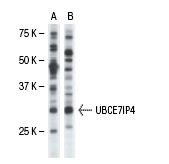
Western blot analysis of UBCE7IP4 expression in HeLa (A) and CHO (B) who cell lysates.Application
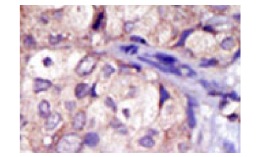
Immunoperoxidase staining of formalin fixed, paraffin-embedded human cancer tissue showing cytoplasmic staining.| Product Name | UBCE7IP4 Antibody (N-23) |
|---|---|
| Antibody Type | Primary Antibodies |
| Antigen Alias | recommended for detection of UBCE7IP4 of human and hamster origin by WB, IP, IF, IHC(P) and ELISA |
| Modification Notes | Ubiquitination is an important mechanism through which three classes of enzymes act in concert to target short-lived or abnormal proteins for destruction. The three classes of enzymes involved in ubiquitination are the ubiquitin-activating enzymes (E1s), the ubiquitin-conjugating enzymes (E2s) and the ubiquitin-protein ligases (E3s). UBCE7IP4 (Ubiquitin-conjugating enzyme 7-interacting protein 4), also known as RNF144A (RING finger protein 144A), KIAA0161 or RNF144, is a 292 amino acid single-pass membrane protein that contains one RING-type zinc finger and two IBR-type zinc fingers. Functioning as an E3 ubiquitin-protein ligase, UBCE7IP4 accepts ubiquitin (in the form of a thioester) from E2 ubiquitin-conjugating enzymes, such as UBC8 and UBCH7, and transfers that ubiquitin residue to target substrates. Via its RING finger, UBCE7IP4 may play a role in protein-DNA and protein-protein interactions throughout the cell. |
| Clonality | Polyclonal |
|---|---|
| Isotype | IgG |
| Host Species | Rabbit |
| Tested Applications | WBIPIFIHCELISA |
| WB:1:500~1:2000 IP:1:100~1:500 IF:1:200~1:500 IHC:1:50~1:200 Notes:Optimal dilutions/concentrations should be determined by the researcher. |
|
| Species Reactivity | HumanMouseRat |
| Concentration | 1mg/ml |
| Purification | Affinity purified |
| Alternative Names | recommended for detection of UBCE7IP4 of human and hamster origin by WB IP IF IHC(P) and ELISA |
|---|---|
| Tissue Specificity | recommended for detection of UBCE7IP4 of human and hamster origin by WB, IP, IF, IHC(P) and ELISA |
| Entrez Gene | 9781 |
|---|
Application
Western blot analysis of UBCE7IP4 expression in HeLa (A) and CHO (B) who cell lysates.
Application
Immunoperoxidase staining of formalin fixed, paraffin-embedded human cancer tissue showing cytoplasmic staining.| Application Notes | WB:1:500~1:2000 IP:1:100~1:500 IF:1:200~1:500 IHC:1:50~1:200 Notes:Optimal dilutions/concentrations should be determined by the researcher. |
|---|
| Form | Liquid |
|---|---|
| Storage Instructions | For short-term storage, store at 4° C. For long-term storage, aliquot and store at -20ºC or below. Avoid multiple freeze-thaw cycles. |
| Storage Buffer | phosphate buffered saline , pH 7.4, 150mM NaCl, 0.02% sodium azide and 50% glycerol. |


