Application
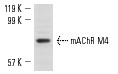
Western blot analysis of mAChR M4 expression in CCD-1064Sk whole cell lysate.| Product Name | mAChR M4 Antibody (H-175) |
|---|---|
| Antibody Type | Primary Antibodies |
| Antigen Alias | epitope corresponding to amino acids 220-394 mapping within an internal region of muscarinic acetylcholine receptor M4 of human origin |
| Modification Notes | The muscarinic acetylcholine receptors (mAChR) mediate a variety of cellular responses, including inhibition of adenylate cyclase, breakdown of phosphoinositides and modulation of potassium channels. The mAChRs transduce signals by coupling to G-proteins, which then modulate several downstream effector proteins and ion channels. Five mAChR subtypes have been identified, designated M1 to M5. The five receptor subtypes show distinct patterns of tissue distribution, as well as distinct pharmacological and functional properties. The amino acid sequence of each mAChR subtype reflects a structure that is characteristic of G-protein coupled receptors, consisting of seven highly conserved transmembrane segments and a large intracellular region unique to each subtype, which constitutes the effector-coupling domain. |
| Clonality | Polyclonal |
|---|---|
| Isotype | IgG |
| Host Species | Rabbit |
| Tested Applications | WBIPIFELISA |
| recommended for detection of mAChR M4 of mouse, rat and human origin by WB, IP, IF and ELISA also reactive with additional species, including canine, bovine and porcine: |
|
| Species Reactivity | HumanMouseRat |
| Concentration | 1mg/ml |
| Purification | Affinity purified |
| Alternative Names | epitope corresponding to amino acids 220-394 mapping within an internal region of muscarinic acetylcholine receptor M4 of human origin |
|---|---|
| Tissue Specificity | epitope corresponding to amino acids 220-394 mapping within an internal region of muscarinic acetylcholine receptor M4 of human origin |
| Entrez Gene | 1132 |
|---|
Application
Western blot analysis of mAChR M4 expression in CCD-1064Sk whole cell lysate.| Application Notes | recommended for detection of mAChR M4 of mouse, rat and human origin by WB, IP, IF and ELISA also reactive with additional species, including canine, bovine and porcine: |
|---|
| Form | Liquid |
|---|---|
| Storage Instructions | For short-term storage, store at 4° C. For long-term storage, aliquot and store at -20ºC or below. Avoid multiple freeze-thaw cycles. |
| Storage Buffer | phosphate buffered saline , pH 7.4, 150mM NaCl, 0.02% sodium azide and 50% glycerol. |


