Application
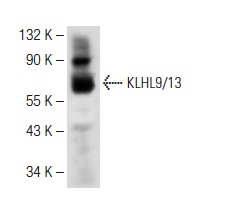
Western blot analysis of KLHL9/13 expression in mouse testis tissue extract.| Product Name | KLHL9/13 Antibody (H-286) |
|---|---|
| Antibody Type | Primary Antibodies |
| Antigen Alias | epitope corresponding to amino acids 329-614 mapping near the C-terminus of KLHL9 of human origin |
| Modification Notes | The BTB (Broad-Complex, Tramtrack and Bric a brac) domain, also known as the POZ (Poxvirus and Zinc finger) domain, is an N-terminal homodimerization domain that contains multiple copies of kelch repeats and/or C2H2-type zinc fingers. Proteins that contain BTB domains are thought to be involved in transcriptional regulation via control of chromatin structure and function. KLHL9 (kelch-like 9) is a 617 amino acid protein containing one BACK (BTB/kelch associated) domain, six kelch repeats and a BTB/POZ domain. KLHL13 (kelch-like 13), also known as BKLHD2, is a 604 amino acid protein that contains six kelch repeats and one BTB/POZ domain. KLHL9 and KLHL13 are believed to play a role in protein ubiquitination and may function as a substrate-specific adapters of an E3 ubiquitin-protein ligase complex with CUL-3. E3 ligases accept a ubiquitin residue from an E2 ubiquitin-conjugating enzyme and immediately transfer that residue to a protein that is targeted for degradation. |
| Clonality | Polyclonal |
|---|---|
| Isotype | IgG |
| Host Species | Rabbit |
| Tested Applications | WBIPIFELISA |
| recommended for detection of KLHL9 and KLHL13 of mouse, rat and human origin by WB, IP, IF and ELISA also reactive with additional species, including equine, canine, bovine, porcine and avian: |
|
| Species Reactivity | HumanMouseRat |
| Concentration | 1mg/ml |
| Purification | Affinity purified |
| Alternative Names | epitope corresponding to amino acids 329-614 mapping near the C-terminus of KLHL9 of human origin |
|---|---|
| Tissue Specificity | epitope corresponding to amino acids 329-614 mapping near the C-terminus of KLHL9 of human origin |
| Entrez Gene | 11275 |
|---|
Application
Western blot analysis of KLHL9/13 expression in mouse testis tissue extract.| Application Notes | recommended for detection of KLHL9 and KLHL13 of mouse, rat and human origin by WB, IP, IF and ELISA also reactive with additional species, including equine, canine, bovine, porcine and avian: |
|---|
| Form | Liquid |
|---|---|
| Storage Instructions | For short-term storage, store at 4° C. For long-term storage, aliquot and store at -20ºC or below. Avoid multiple freeze-thaw cycles. |
| Storage Buffer | phosphate buffered saline , pH 7.4, 150mM NaCl, 0.02% sodium azide and 50% glycerol. |


