Application
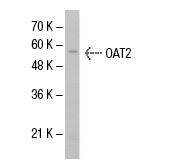
Western blot analysis of OAT2 expression in Jurkat whole cell lysate.| Product Name | OAT2 Antibody (G-18) |
|---|---|
| Antibody Type | Primary Antibodies |
| Antigen Alias | raised against OAT2 of human origin |
| Modification Notes | The organic anion transporter (OAT) family of proteins is comprised of OAT1 (SLC22A6), OAT2 (SLC22A7), OAT3 (SLC22A8), OAT4 (SLC22A11), OAT5 (SLC22A19), OAT6 (SLC22A20) and URAT1 (SLC22A12). The OAT family mediates the absorption, distribution and excretion of endogenous metabolites, such as urate and acidic neurotransmitter metabolites, as well as a multitude of exogenous compounds, including antibiotics, antihypertensives, antivirals, anti-inflammatory drugs, diuretics and uricosurics. Members of the OAT family are mainly located in kidney with some specific members also being expressed in liver, placenta and brain. Disruption of OAT function in any of these organs may lead to renal, hepatic, neurological and fetal toxicity and diseases. OAT2 is highly expressed in liver, but also shows expression in kidney. OAT2 is a multi-specific exchanger that has been shown to mediate the transport of propionate, bumetanide, estrone sulfate, glutarate, dehydroepiandrosterone sulfate, allopurinol, prostaglandin E2, 5-fluorouracil, paclitaxel and L-ascorbic acid. The OAT2 isoform also displays a sex- and species-related differential expression with a greater expression in females due to a strong androgen inhibition and weak estrogen and progesterone stimulation. |
| Clonality | Polyclonal |
|---|---|
| Isotype | IgG |
| Host Species | Rabbit |
| Tested Applications | WBIPIFIHCELISA |
| recommended for detection of OAT2 of human origin by WB, IP, IF, IHC(P) and ELISA: |
|
| Species Reactivity | HumanMouseRat |
| Concentration | 1mg/ml |
| Purification | Affinity purified |
| Alternative Names | raised against OAT2 of human origin |
|---|---|
| Tissue Specificity | raised against OAT2 of human origin |
| Entrez Gene | 10864 |
|---|
Application
Western blot analysis of OAT2 expression in Jurkat whole cell lysate.| Application Notes | recommended for detection of OAT2 of human origin by WB, IP, IF, IHC(P) and ELISA: |
|---|
| Form | Liquid |
|---|---|
| Storage Instructions | For short-term storage, store at 4° C. For long-term storage, aliquot and store at -20ºC or below. Avoid multiple freeze-thaw cycles. |
| Storage Buffer | phosphate buffered saline , pH 7.4, 150mM NaCl, 0.02% sodium azide and 50% glycerol. |


