Application
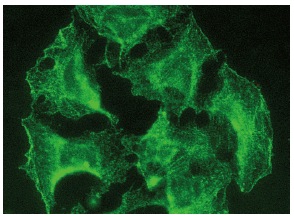
Immunofluorescence staining of methanol-fixed HeLa cells showing membrane localization.Application
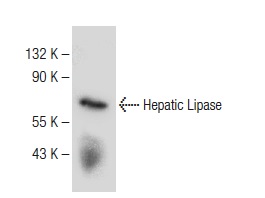
Western blot analysis of Hepatic Lipase expression in MCF7 whole cell lysate.| Product Name | Hepatic Lipase Antibody (H-70) |
|---|---|
| Antibody Type | Primary Antibodies |
| Antigen Alias | epitope corresponding to amino acids 91-160 mapping near the N-terminus of Hepatic Lipase of human origin |
| Modification Notes | The Lipase family belongs to one of the most robust genetic superfamilies found in living organisms that includes esterases and thioesterases. Lipase gene products are related by tertiary structure rather than primary amino acid sequence. Balancing the composition and the transport of lipoproteins in human plasma is essential for normal body function and is mediated in part by Hepatic Lipase, also known as HL or LIPC. Rare deficiencies in Hepatic Lipase have been identified in humans which lead to pathologic levels of circulating lipoprotein particles; this condition is associated with coronary artery disease (CAD). Hepatic Lipase is regulated by thyroid hormones and has a dual function as a triglyceride hydrolase and a ligand/bridging factor for receptor-mediated lipoprotein uptake. Hepatic Lipase localizes to the endothelial surfaces of extrahepatic tissues. The human Hepatic Lipase gene maps to chromosome 15q22.1, spans over 60 kb, contains nine exons and eight introns, and encodes a 499 amino acid protein. |
| Clonality | Polyclonal |
|---|---|
| Isotype | IgG |
| Host Species | Rabbit |
| Tested Applications | WBIPIFIHCELISA |
| recommended for detection of Hepatic Lipase of mouse, rat and human origin by WB, IP, IF, IHC(P) and ELISA: |
|
| Species Reactivity | HumanMouseRat |
| Concentration | 1mg/ml |
| Purification | Affinity purified |
| Alternative Names | epitope corresponding to amino acids 91-160 mapping near the N-terminus of Hepatic Lipase of human origin |
|---|---|
| Tissue Specificity | epitope corresponding to amino acids 91-160 mapping near the N-terminus of Hepatic Lipase of human origin |
| Entrez Gene | 3990 |
|---|
Application
Immunofluorescence staining of methanol-fixed HeLa cells showing membrane localization.
Application
Western blot analysis of Hepatic Lipase expression in MCF7 whole cell lysate.| Application Notes | recommended for detection of Hepatic Lipase of mouse, rat and human origin by WB, IP, IF, IHC(P) and ELISA: |
|---|
| Form | Liquid |
|---|---|
| Storage Instructions | For short-term storage, store at 4° C. For long-term storage, aliquot and store at -20ºC or below. Avoid multiple freeze-thaw cycles. |
| Storage Buffer | phosphate buffered saline , pH 7.4, 150mM NaCl, 0.02% sodium azide and 50% glycerol. |


