Application
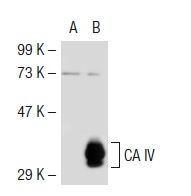
Western blot analysis of CA IV expression in non-transfected: (A) and mouse CA IV transfected: (B) 293T whole cell lysates.Application
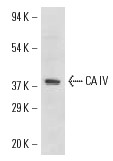
Western blot analysis of CA IV expression in mouse kidney tissue extract.| Product Name | CA IV Antibody (M-50) |
|---|---|
| Antibody Type | Primary Antibodies |
| Antigen Alias | epitope corresponding to amino acids 1-50 mapping at the N-terminus of CA IV of mouse origin |
| Modification Notes | Carbonic anhydrase IV (CA IV) is glycosylphosphotidylinositol-anchored to the outer surface of the plasma membrane where it catalyzes hydration-dehydration of CO(2)/HCO(3)(-). CA IV is present on the plasma face of microcapillaries and in the choriocapillaris of the human eye. CA IV facilitates renal acidification in the kidney and is responsible for the regulation of interstitial pH (pH(o)) transients in brain. Impairment in targetting leads to disruption of HCO3- secretion and associates with malfunction in cystic fibrosis cells. Carbonic anhydrases are zinc metalloenzymes that catalyze the reversible hydration of carbon dioxide. They participate in respiration, calcification, acid-base balance, bone resorption, and the formation of aqueous humor, cerebrospinal fluid, saliva, and gastric acid. Carbonic anhydrases show extensive diversity in tissue distribution and in their subcellular localization. |
| Clonality | Polyclonal |
|---|---|
| Isotype | IgG |
| Host Species | Rabbit |
| Tested Applications | WBIPIFELISA |
| recommended for detection of CA IV of mouse and rat origin by WB, IP, IF and ELISA: |
|
| Species Reactivity | HumanMouseRat |
| Concentration | 1mg/ml |
| Purification | Affinity purified |
| Alternative Names | epitope corresponding to amino acids 1-50 mapping at the N-terminus of CA IV of mouse origin |
|---|---|
| Tissue Specificity | epitope corresponding to amino acids 1-50 mapping at the N-terminus of CA IV of mouse origin |
| Entrez Gene | 12351 |
|---|
Application
Western blot analysis of CA IV expression in non-transfected: (A) and mouse CA IV transfected: (B) 293T whole cell lysates.
Application
Western blot analysis of CA IV expression in mouse kidney tissue extract.| Application Notes | recommended for detection of CA IV of mouse and rat origin by WB, IP, IF and ELISA: |
|---|
| Form | Liquid |
|---|---|
| Storage Instructions | For short-term storage, store at 4° C. For long-term storage, aliquot and store at -20ºC or below. Avoid multiple freeze-thaw cycles. |
| Storage Buffer | phosphate buffered saline , pH 7.4, 150mM NaCl, 0.02% sodium azide and 50% glycerol. |


