Application
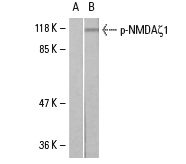
Western blot analysis of phosphorylated NMDAζ1 expression in untreated (A) and estradiol-treated (B) MCF7 whole cell lysates.| Product Name | p-NMDAζ1 Antibody (Ser 896) |
|---|---|
| Antibody Type | Primary Antibodies |
| Antigen Alias | epitope corresponding to phosphorylated Ser 896 of NMDAζ1 of human origin |
| Modification | Phosphoralated |
| Modification Notes | Glutamate receptors mediate most excitatory neurotransmission in the brain and play an important role in neural plasticity, neural development and neurodegeneration. Ionotropic glutamate receptors are categorized into NMDA receptors and kainate/ AMPA receptors, both contain glutamate-gated ion channels. The NMDA receptors consist of five subunits: epsilon 1, 2, 3, 4 and one zeta subunit. The zeta subunit is expressed throughout the brainstem whereas the four epsilon subunits display limited distribution. Phosphorylation is an important mechanism for the regulation of ligand-gated ion channels, including NMDA receptors. NMDA receptor phosphorylation by PKA and PKC can be induced via the activation of beta-adrenergic receptors, and metabotropic glutamate or opioid receptors, respectively. |
| Clonality | Polyclonal |
|---|---|
| Isotype | IgG |
| Host Species | Rabbit |
| Tested Applications | WBIP |
| recommended for detection of Ser 896 phosphorylated NMDAζ1 of mouse, rat and human origin by WB and IP: |
|
| Species Reactivity | HumanMouseRat |
| Concentration | 1mg/ml |
| Purification | Affinity purified |
| Alternative Names | epitope corresponding to phosphorylated Ser 896 of NMDA&zeta 1 of human origin |
|---|---|
| Tissue Specificity | epitope corresponding to phosphorylated Ser 896 of NMDAζ1 of human origin |
| Entrez Gene | 2902 |
|---|
Application
Western blot analysis of phosphorylated NMDAζ1 expression in untreated (A) and estradiol-treated (B) MCF7 whole cell lysates.| Application Notes | recommended for detection of Ser 896 phosphorylated NMDAζ1 of mouse, rat and human origin by WB and IP: |
|---|
| Form | Liquid |
|---|---|
| Storage Instructions | For short-term storage, store at 4° C. For long-term storage, aliquot and store at -20ºC or below. Avoid multiple freeze-thaw cycles. |
| Storage Buffer | phosphate buffered saline , pH 7.4, 150mM NaCl, 0.02% sodium azide and 50% glycerol. |


