Application
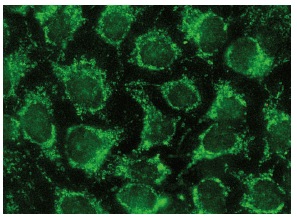
Immunofluorescence staining of methanol-fixed HeLa cells showing cytoplasmic localization.Application
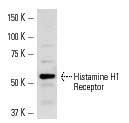
Western blot analysis of Histamine H1 Receptor expression in JAR whole cell lysate.| Product Name | Histamine H1 Receptor Antibody (H-300) |
|---|---|
| Antibody Type | Primary Antibodies |
| Antigen Alias | epitope corresponding to amino acids 111-410 mapping near the C-terminus of Histamine H1 Receptor of human origin |
| Modification Notes | Histamine is an inflammatory mediator that is ubiquitously expressed and has a broad range of pharmacologic effects. Specifically, it plays a role in the central nervous, gastrointestinal, respiratory and immune systems. The effects of histamine are mediated by a family of G protein-coupled receptors, the Histamine H1, H2, H3 and H4 Receptors. The gene encoding the human Histamine H1 Receptor maps to chromosome 3p25 and is expressed in highest abundance in placenta, with lower levels in lung, skeletal muscle, kidney and brain. The murine Histamine H2 Receptor gene maps to chromosome 13 and is highly expressed in stomach with moderate expression in brain and heart. The gene encoding the human Histamine H3 Receptor is located on chromosome 20 and is expressed as six alternative splice variants in thalamus. The human Histamine H4 Receptor gene maps to chromosome 18q11 and is expressed most abundantly in bone marrow and spleen in addition to peripheral blood leukocytes, thymus, small intestine and colon. The histamine receptors respond to several agonists and antagonists, which make them potential therapeutic targets for several diseases, such as asthma, epilepsy and cardiac ischemia. |
| Clonality | Polyclonal |
|---|---|
| Isotype | IgG |
| Host Species | Rabbit |
| Tested Applications | WBIPIFELISA |
| recommended for detection of Histamine H1 Receptor of mouse, rat and human origin by WB, IP, IF and ELISA: |
|
| Species Reactivity | HumanMouseRat |
| Concentration | 1mg/ml |
| Purification | Affinity purified |
| Alternative Names | epitope corresponding to amino acids 111-410 mapping near the C-terminus of Histamine H1 Receptor of human origin |
|---|---|
| Tissue Specificity | epitope corresponding to amino acids 111-410 mapping near the C-terminus of Histamine H1 Receptor of human origin |
| Entrez Gene | 3269 |
|---|
Application
Immunofluorescence staining of methanol-fixed HeLa cells showing cytoplasmic localization.
Application
Western blot analysis of Histamine H1 Receptor expression in JAR whole cell lysate.| Application Notes | recommended for detection of Histamine H1 Receptor of mouse, rat and human origin by WB, IP, IF and ELISA: |
|---|
| Form | Liquid |
|---|---|
| Storage Instructions | For short-term storage, store at 4° C. For long-term storage, aliquot and store at -20ºC or below. Avoid multiple freeze-thaw cycles. |
| Storage Buffer | phosphate buffered saline , pH 7.4, 150mM NaCl, 0.02% sodium azide and 50% glycerol. |


