Application
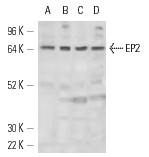
Western blot analysis of EP2 expression in JAR (A), JEG-3 (B), WI 38 (C) and NRK (D) whole cell lysates.| Product Name | EP2 Antibody (H-75) |
|---|---|
| Antibody Type | Primary Antibodies |
| Antigen Alias | epitope corresponding to amino acids 1-75 mapping at the N-terminus of EP2 of human origin |
| Modification Notes | Prostaglandin E2, a member of the autacoid family of lipid mediators, is a major renal cyclooxygenase product of arachidonic acid metabolism. Prostaglandin E2 binds to four G protein-coupled E-prostanoid receptors, designated EP1, EP2, EP3 and EP4. The expression and function of the prostaglandin E2 receptors have been highly characterized in kidney. EP1, which is predominantly expressed in the collecting duct, couples to Gq proteins to inhibit sodium absorption and increase in intracellular calcium, which act as second messengers. EP2 is coupled to Gs proteins, which stimulate adenylyl cyclase. EP2 has the lowest expression in kidney, but EP2 knockout mice exhibit salt-sensitive hypertension, which suggests a role for EP2 in salt excretion. EP3 is expressed in renal vessels, thick ascending limb and collecting duct. EP3 has at least six alternative splice variants that couple to Gi proteins to inhibit cAMP, which subsequently inhibit sodium and water transport. In uterus, EP3 induces the contraction of uterine smooth muscles. EP4 is expressed in glomerulus and collecting duct. It couples to Gs proteins, which stimulate adenylyl cyclase and regulate glomerular tone and renal renin release. |
| Clonality | Polyclonal |
|---|---|
| Isotype | IgG |
| Host Species | Rabbit |
| Tested Applications | WBIPIFELISA |
| recommended for detection of EP2 of mouse, rat and human origin by WB, IP, IF and ELISA also reactive with additional species, including equine: |
|
| Species Reactivity | HumanMouseRat |
| Concentration | 1mg/ml |
| Purification | Affinity purified |
| Alternative Names | epitope corresponding to amino acids 1-75 mapping at the N-terminus of EP2 of human origin |
|---|---|
| Tissue Specificity | epitope corresponding to amino acids 1-75 mapping at the N-terminus of EP2 of human origin |
| Entrez Gene | 5732 |
|---|
Application
Western blot analysis of EP2 expression in JAR (A), JEG-3 (B), WI 38 (C) and NRK (D) whole cell lysates.| Application Notes | recommended for detection of EP2 of mouse, rat and human origin by WB, IP, IF and ELISA also reactive with additional species, including equine: |
|---|
| Form | Liquid |
|---|---|
| Storage Instructions | For short-term storage, store at 4° C. For long-term storage, aliquot and store at -20ºC or below. Avoid multiple freeze-thaw cycles. |
| Storage Buffer | phosphate buffered saline , pH 7.4, 150mM NaCl, 0.02% sodium azide and 50% glycerol. |


