Application
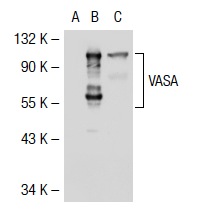
Western blot analysis of VASA expression in non-transfected 293T: (A) and human VASA transfected 293T: (B) whole cell lysates and rat testis tissue extract (C).| Product Name | VASA Antibody (H-80) |
|---|---|
| Antibody Type | Primary Antibodies |
| Antigen Alias | epitope corresponding to amino acids 631-710 mapping near the C-terminus of VASA of human origin |
| Modification Notes | VASA is a 724 amino acid, ATP-dependent RNA helicase that belongs to the DEAD-box family. VASA is specifically expressed in germline cells throughout the life cycle and is undetectable in somatic tissues. In vertebrates, VASA is restricted to bisexually reproducing organisms. It is cytoplasmic and is present only in migratory primordial germ cells in the region of the gonadal ridge. On testicular sections, VASA expression is the highest in spermatogonia, reduced in spermatocytes, low in spermatids and absent in sperm. In the ovary, VASA expression is the highest in oogonia but persists throughout oogenesis. VASA has a glycine-rich N-terminus with multiple repeats of an RGG motif believed to function in RNA binding. Specifically, it regulates the translation of intricate mRNAs that are essential for differentiation. |
| Clonality | Polyclonal |
|---|---|
| Isotype | IgG |
| Host Species | Rabbit |
| Tested Applications | WBIPIFELISA |
| recommended for detection of VASA of mouse, rat and human origin by WB, IP, IF and ELISA also reactive with additional species, including equine, canine, bovine and porcine: |
|
| Species Reactivity | HumanMouseRat |
| Concentration | 1mg/ml |
| Purification | Affinity purified |
| Alternative Names | epitope corresponding to amino acids 631-710 mapping near the C-terminus of VASA of human origin |
|---|---|
| Tissue Specificity | epitope corresponding to amino acids 631-710 mapping near the C-terminus of VASA of human origin |
| Entrez Gene | 54514 |
|---|
Application
Western blot analysis of VASA expression in non-transfected 293T: (A) and human VASA transfected 293T: (B) whole cell lysates and rat testis tissue extract (C).| Application Notes | recommended for detection of VASA of mouse, rat and human origin by WB, IP, IF and ELISA also reactive with additional species, including equine, canine, bovine and porcine: |
|---|
| Form | Liquid |
|---|---|
| Storage Instructions | For short-term storage, store at 4° C. For long-term storage, aliquot and store at -20ºC or below. Avoid multiple freeze-thaw cycles. |
| Storage Buffer | phosphate buffered saline , pH 7.4, 150mM NaCl, 0.02% sodium azide and 50% glycerol. |


