Application
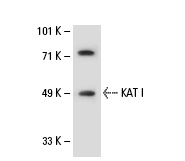
Western blot analysis of KAT I expression in HeLa whole cell lysate.| Product Name | KAT I Antibody (H-74) |
|---|---|
| Antibody Type | Primary Antibodies |
| Antigen Alias | epitope corresponding to amino acids 255-328 mapping near the C-terminus of KAT I of human origin |
| Modification Notes | Kynurenine aminotransferases KAT I, KAT II, and KAT III belong to the class-I pyridoxal-phosphate-dependent aminotransferase family. KAT I is a cytoplasmic protein involved in glutamine catabolism. KAT I functions in the catalysis of the transamination of L-kinurenine to form kynurenic acid, a neuroprotective and anticonvulsant metabolite of tryptophan. Kynurenic acid is involved in synaptic transmission and has been implicated in a number of neurological disorders including schizophrenia and Huntington’s disease. KAT I also functions in the metabolism of cysteine conjugates in some halogenated alkenes and alkanes to form reactive metabolites. KAT I has three isoforms. Isoform 1is the full length protein, isoform 2 lacks amino acids 68-117 and isoform 3 lacks amino acids 251-422. Based on sequence similarity, KAT I is thought to function as a homodimer. |
| Clonality | Polyclonal |
|---|---|
| Isotype | IgG |
| Host Species | Rabbit |
| Tested Applications | WBIPIFELISA |
| recommended for detection of KAT I isoforms 1 and 2 of human and, to a lesser extent, mouse and rat origin by WB, IP, IF and ELISA also reactive with additional species, including canine: |
|
| Species Reactivity | HumanMouseRat |
| Concentration | 1mg/ml |
| Purification | Affinity purified |
| Alternative Names | epitope corresponding to amino acids 255-328 mapping near the C-terminus of KAT I of human origin |
|---|---|
| Tissue Specificity | epitope corresponding to amino acids 255-328 mapping near the C-terminus of KAT I of human origin |
| Entrez Gene | 883 |
|---|
Application
Western blot analysis of KAT I expression in HeLa whole cell lysate.| Application Notes | recommended for detection of KAT I isoforms 1 and 2 of human and, to a lesser extent, mouse and rat origin by WB, IP, IF and ELISA also reactive with additional species, including canine: |
|---|
| Form | Liquid |
|---|---|
| Storage Instructions | For short-term storage, store at 4° C. For long-term storage, aliquot and store at -20ºC or below. Avoid multiple freeze-thaw cycles. |
| Storage Buffer | phosphate buffered saline , pH 7.4, 150mM NaCl, 0.02% sodium azide and 50% glycerol. |


