Application
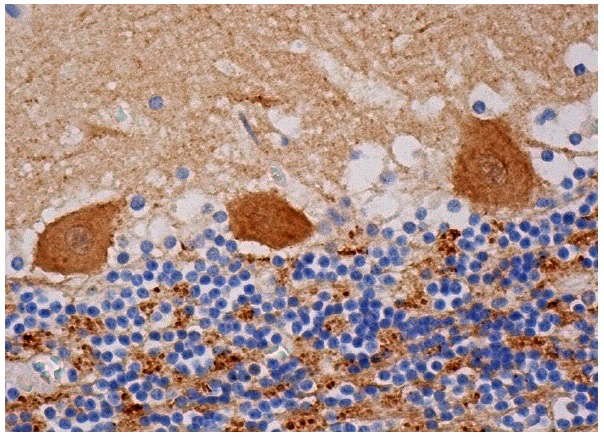
Immunoperoxidase staining of formalin fixed, paraffin-embedded human cerebellum tissue showing nuclear and cytoplasmic staining of Purkinje cells and cytoplasmic staining of cells in molecular layer.| Product Name | FOXP2 Antibody (H-90) |
|---|---|
| Antibody Type | Primary Antibodies |
| Antigen Alias | epitope corresponding to amino acids 583-672 mapping near the C-terminus of FOXP2 of human origin |
| Modification Notes | The FOX family of transcription factors is a large group of proteins that share a common DNA binding domain termed a winged-helix or forkhead domain. During early development, FOXP1 and FOXP2 are expressed abundantly in the lung with lower levels of expression in neural, intestinal and cardiovascular tissues, where they act as transcription repressors. FOXP1 is widely expressed in adult tissues, while neoplastic cells often exhibit a dramatic change in expression level or localization of FOXP1. The gene encoding human FOXP1 maps to chromosome 3p14.1. The gene encoding human FOXP2 maps to chromosome 7q31. The gene encoding FOXP3, a third member of this family, maps to chromosome Xp11.23-Xq13.3. Mutations in this gene cause IPEX, a fatal, X-linked inherited disorder characterized by immune dysregulation. The FOXP3 protein, also known as scurfin, is essential for normal immune homeostasis. Specifically, FOXP3 represses transcription through a DNA binding forkhead domain, thereby regulating T-cell activation. |
| Clonality | Polyclonal |
|---|---|
| Isotype | IgG |
| Host Species | Rabbit |
| Tested Applications | WBIPIFIHCELISAGSChIP |
| recommended for detection of FOXP2 of mouse, rat and human origin by WB, IP, IF, IHC(P) and ELISA also reactive with additional species, including equine, canine, bovine, porcine and avian: |
|
| Species Reactivity | HumanMouseRat |
| Concentration | 1mg/ml |
| Purification | Affinity purified |
| Alternative Names | epitope corresponding to amino acids 583-672 mapping near the C-terminus of FOXP2 of human origin |
|---|---|
| Tissue Specificity | epitope corresponding to amino acids 583-672 mapping near the C-terminus of FOXP2 of human origin |
| Entrez Gene | 93986 |
|---|
Application
Immunoperoxidase staining of formalin fixed, paraffin-embedded human cerebellum tissue showing nuclear and cytoplasmic staining of Purkinje cells and cytoplasmic staining of cells in molecular layer.| Application Notes | recommended for detection of FOXP2 of mouse, rat and human origin by WB, IP, IF, IHC(P) and ELISA also reactive with additional species, including equine, canine, bovine, porcine and avian: |
|---|
| Form | Liquid |
|---|---|
| Storage Instructions | For short-term storage, store at 4° C. For long-term storage, aliquot and store at -20ºC or below. Avoid multiple freeze-thaw cycles. |
| Storage Buffer | phosphate buffered saline , pH 7.4, 150mM NaCl, 0.02% sodium azide and 50% glycerol. |


