Application
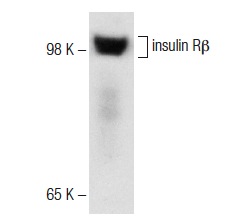
Western blot analysis of insulin Rβ expression in rat skeletal muscle tissue extract.| Product Name | Insulin Rβ Antibody (H-70) AC |
|---|---|
| Antibody Type | Primary Antibodies |
| Antigen Alias | epitope corresponding to amino acids 941-1010 of insulin Rβ of human origin |
| Modification Notes | The insulin receptor (IR) is a heterodimeric protein complex that has an intracellular β subunit and an extracellular α subunit, which is disulfide- linked to a transmembrane segment. The insulin ligand binds to the IR and initiates molecular signaling pathways that promote glucose uptake in cells and glycogen synthesis. Insulin binding to IR induces phosphorylation of intracellular tyrosine kinase domains and recruitment of multiple SH2 and SH3 domain-containing intracellular proteins that serve as signaling intermediates for pleiotropic effects of insulin. The human insulin receptor gene maps to chromosome 19p13.3-p13.2 and encodes a 1382 amino acid protein that cleaves to form α and β subunits. Type 1 diabetes is an auto-immune condition of the endocrine pancreas that results in destruction of insulin secreting cells and a progressive loss in insulin-sensitive glucose uptake by cells. Type 2 diabetes is a condition where cells become resistant to insulin action. |
| Clonality | Polyclonal |
|---|---|
| Isotype | IgG |
| Host Species | Rabbit |
| Tested Applications | WBIPIFELISA |
| recommended for detection of insulin Rβ of mouse, rat and human origin by WB, IP, IF and ELISA also reactive with additional species, including equine, canine, bovine and porcine: |
|
| Species Reactivity | HumanMouseRat |
| Concentration | 1mg/ml |
| Purification | Affinity purified |
| Alternative Names | epitope corresponding to amino acids 941-1010 of insulin R&beta of human origin |
|---|---|
| Tissue Specificity | epitope corresponding to amino acids 941-1010 of insulin Rβ of human origin |
| Entrez Gene | 3643 |
|---|
Application
Western blot analysis of insulin Rβ expression in rat skeletal muscle tissue extract.| Application Notes | recommended for detection of insulin Rβ of mouse, rat and human origin by WB, IP, IF and ELISA also reactive with additional species, including equine, canine, bovine and porcine: |
|---|
| Form | Liquid |
|---|---|
| Storage Instructions | For short-term storage, store at 4° C. For long-term storage, aliquot and store at -20ºC or below. Avoid multiple freeze-thaw cycles. |
| Storage Buffer | phosphate buffered saline , pH 7.4, 150mM NaCl, 0.02% sodium azide and 50% glycerol. |


