Application
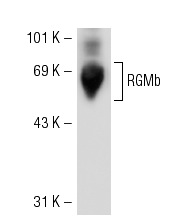
Western blot analysis of RGMb expression in mouse pancreas tissue extract.| Product Name | RGMb Antibody (H-60) |
|---|---|
| Antibody Type | Primary Antibodies |
| Antigen Alias | epitope corresponding to amino acids 46-105 mapping near the N-terminus of RGMb of human origin |
| Modification Notes | The repulsive guidance molecule (RGM) family of proteins are important in the guidance of growth cones of developing neurons. They are repulsive for a group of axons, those from the temporal half of the retina. RGM have been implicated in both axonal guidance and neural tube closure but as opposed to for ephrins, semaphorins, netrins and slits, no receptor mechanism for RGM activation has been defined. Dorsal root ganglion axons do not respond to RGM but neogenin (a netrin-binding protein which can function as an RGM receptor) expression can spur RGM responsiveness. The RGM proteins are attached to the membrane by a GPI-anchor. Two members of this family, RGMa and RGMb, are expressed in the nervous system. RGMc, also known as Hemojuvelin, is a part of the signaling pathway activating hepcidin and works together with hepcidin to restrict iron absorption in the gut. Defects in the gene encoding for RGMc causes the autosomal recessive disorder juvenile hemochromatosis (JH). |
| Clonality | Polyclonal |
|---|---|
| Isotype | IgG |
| Host Species | Rabbit |
| Tested Applications | WBIPIFELISA |
| recommended for detection of RGMb of mouse, rat and human origin by WB, IP, IF and ELISA also reactive with additional species, including equine, canine, bovine and porcine: |
|
| Species Reactivity | HumanMouseRat |
| Concentration | 1mg/ml |
| Purification | Affinity purified |
| Alternative Names | epitope corresponding to amino acids 46-105 mapping near the N-terminus of RGMb of human origin |
|---|---|
| Tissue Specificity | epitope corresponding to amino acids 46-105 mapping near the N-terminus of RGMb of human origin |
| Entrez Gene | 285704 |
|---|
Application
Western blot analysis of RGMb expression in mouse pancreas tissue extract.| Application Notes | recommended for detection of RGMb of mouse, rat and human origin by WB, IP, IF and ELISA also reactive with additional species, including equine, canine, bovine and porcine: |
|---|
| Form | Liquid |
|---|---|
| Storage Instructions | For short-term storage, store at 4° C. For long-term storage, aliquot and store at -20ºC or below. Avoid multiple freeze-thaw cycles. |
| Storage Buffer | phosphate buffered saline , pH 7.4, 150mM NaCl, 0.02% sodium azide and 50% glycerol. |


