Application
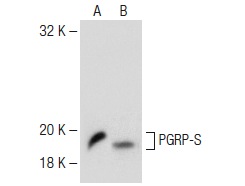
Western blot analysis of PGRP-S expression in Jurkat (A) and HEL 92.1.7 (B) whole cell lysates.| Product Name | PGRP-S Antibody (H-80) |
|---|---|
| Antibody Type | Primary Antibodies |
| Antigen Alias | epitope corresponding to amino acids 96-175 mapping within an internal region of PGRP-S of human origin |
| Modification Notes | Peptidoglycan recognition proteins (PGRPs) are molecules that recognize peptidoglycan, a large component in bacterial cell walls. In insects, PGRPs activate antimicrobial pathways, and in mammals PGRPs function as antibacterial neutrophil proteins. PGRP-L halts bacterial growth by acting as an alanine amidase, an enzyme that hydrolyzes the amide bond of bacterial peptidoglycan. PGRP-Iå and PGRP-I∫ are also members of the PGRP family that help recognize bacteria by binding to peptidoglycan and Gram-positive bacteria, but they do not have amidase activity. PGRP-S participates in intracellular killing of Gram-positive bacteria by stimulating two antimicrobial defense systems, the prophenoloxidase cascade and the antimicrobial peptides through Toll receptors. |
| Clonality | Polyclonal |
|---|---|
| Isotype | IgG |
| Host Species | Rabbit |
| Tested Applications | WBIPIFELISA |
| recommended for detection of PGRP-S of human origin by WB, IP, IF and ELISA: |
|
| Species Reactivity | HumanMouseRat |
| Concentration | 1mg/ml |
| Purification | Affinity purified |
| Alternative Names | epitope corresponding to amino acids 96-175 mapping within an internal region of PGRP-S of human origin |
|---|---|
| Tissue Specificity | epitope corresponding to amino acids 96-175 mapping within an internal region of PGRP-S of human origin |
| Entrez Gene | 8993 |
|---|
Application
Western blot analysis of PGRP-S expression in Jurkat (A) and HEL 92.1.7 (B) whole cell lysates.| Application Notes | recommended for detection of PGRP-S of human origin by WB, IP, IF and ELISA: |
|---|
| Form | Liquid |
|---|---|
| Storage Instructions | For short-term storage, store at 4° C. For long-term storage, aliquot and store at -20ºC or below. Avoid multiple freeze-thaw cycles. |
| Storage Buffer | phosphate buffered saline , pH 7.4, 150mM NaCl, 0.02% sodium azide and 50% glycerol. |


