Application
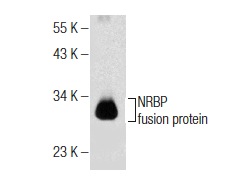
Western blot analysis of human recombinant NRBP fusion protein.| Product Name | NRBP Antibody (H-40) |
|---|---|
| Antibody Type | Primary Antibodies |
| Antigen Alias | epitope corresponding to amino acids 274-313 mapping within an internal region of NRBP of human origin |
| Modification Notes | The nuclear receptor binding protein (NRBP) is a host cellular protein that influences the subcellular trafficking between the endoplasmic reticulum (ER) and the Golgi apparatus via interactions with GTPases. As a multidomain putative adaptor protein, NRBP modulates multiple signaling pathways by regulating the formation of signaling complexes in the cytoplasm. NRBP, which can form a homodimer, binds to MLF1. This binding recruits a serine kinase which phosphorylates both of the proteins, preventing MLF1 from binding to YWHAZ. It is a cytoplasmic protein, but it can co-localize with RAC3 to the endomembrane and can be seen at the cell periphery in lamellipodia. The NRBP gene maps to human chromosome 2p23 and is ubiquitously expressed in human tissues, with highest levels detected in testis. |
| Clonality | Polyclonal |
|---|---|
| Isotype | IgG |
| Host Species | Rabbit |
| Tested Applications | WBIPIFELISA |
| recommended for detection of NRBP of mouse, rat and human origin by WB, IP, IF and ELISA also reactive with additional species, including equine, canine, bovine, porcine and avian: |
|
| Species Reactivity | HumanMouseRat |
| Concentration | 1mg/ml |
| Purification | Affinity purified |
| Alternative Names | epitope corresponding to amino acids 274-313 mapping within an internal region of NRBP of human origin |
|---|---|
| Tissue Specificity | epitope corresponding to amino acids 274-313 mapping within an internal region of NRBP of human origin |
| Entrez Gene | 29959 |
|---|
Application
Western blot analysis of human recombinant NRBP fusion protein.| Application Notes | recommended for detection of NRBP of mouse, rat and human origin by WB, IP, IF and ELISA also reactive with additional species, including equine, canine, bovine, porcine and avian: |
|---|
| Form | Liquid |
|---|---|
| Storage Instructions | For short-term storage, store at 4° C. For long-term storage, aliquot and store at -20ºC or below. Avoid multiple freeze-thaw cycles. |
| Storage Buffer | phosphate buffered saline , pH 7.4, 150mM NaCl, 0.02% sodium azide and 50% glycerol. |


