Application
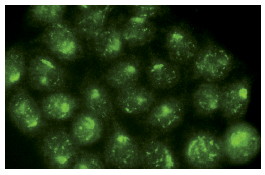
Immunofluorescence staining of methanol-fixed HeLa cells showing nuclear localization.| Product Name | REV1 Antibody (H-300) |
|---|---|
| Antibody Type | Primary Antibodies |
| Antigen Alias | epitope corresponding to amino acids 81-380 mapping near the N-terminus of REV1 of human origin |
| Modification Notes | Originally identified in Saccaromyces cerevisiae, Rev1p exhibits deoxycytidyl transferase activity and is required for translesion replication and mutagenesis induced by a wide variety of DNA-damaging events (1-3). The human homolog REV1, like its yeast Rev1p counterpart, is also involved in translesion replication and spontaneous mutagenesis (1,4,5). The human REV1 gene maps between the chromosomal loci 2q11.1 and 2q11.2 and is ubiquitously expressed in various human tissues (6). Human REV1 protein is a dCMP transferase that specifically inserts a dCMP residue either opposite a DNA template guanine, a DNA template apurinic/apyridinic site or a uracil residue (6). REV1 transferase may play a critical role during mutagenic translesion DNA synthesis by bypassing a template adenosine/guanine site in human cells (6). |
| Clonality | Polyclonal |
|---|---|
| Isotype | IgG |
| Host Species | Rabbit |
| Tested Applications | WBIPIFELISAGSChIP |
| recommended for detection of REV1 of mouse, rat and human origin by WB, IP, IF and ELISA also reactive with additional species, including equine and canine: |
|
| Species Reactivity | HumanMouseRat |
| Concentration | 1mg/ml |
| Purification | Affinity purified |
| Alternative Names | epitope corresponding to amino acids 81-380 mapping near the N-terminus of REV1 of human origin |
|---|---|
| Tissue Specificity | epitope corresponding to amino acids 81-380 mapping near the N-terminus of REV1 of human origin |
| Entrez Gene | 51455 |
|---|
Application
Immunofluorescence staining of methanol-fixed HeLa cells showing nuclear localization.| Application Notes | recommended for detection of REV1 of mouse, rat and human origin by WB, IP, IF and ELISA also reactive with additional species, including equine and canine: |
|---|
| Form | Liquid |
|---|---|
| Storage Instructions | For short-term storage, store at 4° C. For long-term storage, aliquot and store at -20ºC or below. Avoid multiple freeze-thaw cycles. |
| Storage Buffer | phosphate buffered saline , pH 7.4, 150mM NaCl, 0.02% sodium azide and 50% glycerol. |


