Application
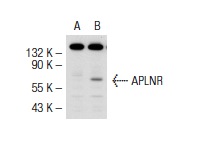
Western blot analysis of APLNR expression in non-transfected: (A) and human APLNR transfected: (B) 293T whole cell lysates.| Product Name | APLNR Antibody (H-300) |
|---|---|
| Antibody Type | Primary Antibodies |
| Antigen Alias | epitope corresponding to amino acids 1-300 mapping at the N-terminus of Apelin Receptor of human origin |
| Modification Notes | The apelin receptor (APLNR) is a G protein-coupled integral membrane protein exhibiting a hypothalamic distribution in brain, glial cells, astrocytes and neuronal subpopulations. APLNR is bound by its cognate neuropeptide ligand, apelin, promoting receptor internalization to the nucleus and dose-dependent inhibition of forskolin-induced cAMP production. However, deletion studies of the apelin agonist have shown that internalization is not mandatory for decreasing vasopressin release, a hypotensive action of APLNR signaling. Further evidence for functional dissociation of APLNR stimulation and internalization was exhibited in vitro using mutational studies of a nuclear localization signal sequence. These findings may suggest the presence of multiple, functionally-differing conformational states for the receptor. Stress studies in rodents have shown APLNR is under negative regulation by glucocorticoids and may be involved in controlling hypothalamic function. APLNR also functions as an alternate coreceptor with CD4 for HIV-1 infection. |
| Clonality | Polyclonal |
|---|---|
| Isotype | IgG |
| Host Species | Rabbit |
| Tested Applications | WBIPIFELISA |
| recommended for detection of APLNR of mouse, rat and human origin by WB, IP, IF and ELISA also reactive with additional species, including equine, canine and porcine: |
|
| Species Reactivity | HumanMouseRat |
| Concentration | 1mg/ml |
| Purification | Affinity purified |
| Alternative Names | epitope corresponding to amino acids 1-300 mapping at the N-terminus of Apelin Receptor of human origin |
|---|---|
| Tissue Specificity | epitope corresponding to amino acids 1-300 mapping at the N-terminus of Apelin Receptor of human origin |
| Entrez Gene | 187 |
|---|
Application
Western blot analysis of APLNR expression in non-transfected: (A) and human APLNR transfected: (B) 293T whole cell lysates.| Application Notes | recommended for detection of APLNR of mouse, rat and human origin by WB, IP, IF and ELISA also reactive with additional species, including equine, canine and porcine: |
|---|
| Form | Liquid |
|---|---|
| Storage Instructions | For short-term storage, store at 4° C. For long-term storage, aliquot and store at -20ºC or below. Avoid multiple freeze-thaw cycles. |
| Storage Buffer | phosphate buffered saline , pH 7.4, 150mM NaCl, 0.02% sodium azide and 50% glycerol. |


