Application
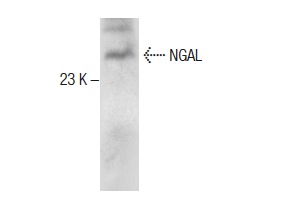
Western blot analysis of NGAL expression in mouse ovary tissue extract.Application
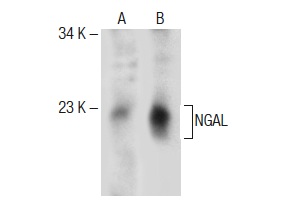
Western blot analysis of NGAL expression in mouse liver (A) and rat brain (B) tissue extracts.| Product Name | NGAL Antibody (M-145) |
|---|---|
| Antibody Type | Primary Antibodies |
| Antigen Alias | epitope corresponding to amino acids 17-161 mapping within an internal region of NGAL of mouse origin |
| Modification Notes | In addition to the monomeric mammalian progelatinase, two additional forms of progelatinase have been identified. The shorter of these additional forms is a covalently linked, disulfide-bridged protein that heterodimerizes with a short protein; an å2-Microglobulin-related protein known as neutrophil gelatinase-associated lipocalin (NGAL), which is moderately expressed in breast and lung tissues. NGAL belongs to the lipocalin family and has a high degree of similarity with rat å2-Microglobulin-related protein and mouse protein 24p3. NGAL is able to bind a derivative of the bacterial chemotactic peptide, suggesting that it has important immuno-modulatory functions. NGAL has been described as an inflammatory protein; it is released into the circulation as a result of the inflammatory activation of leukocytes initiated by the extra-corporeal circulation. In addition, NGAL synthesis is induced in epithelial cells in inflammatory and neoplastic colorectal diseases. In conclusion, NGAL may serve as a scavenger of bacterial products to function in the anti-inflammatory process. |
| Clonality | Polyclonal |
|---|---|
| Isotype | IgG |
| Host Species | Rabbit |
| Tested Applications | WBIPIFELISA |
| recommended for detection of NGAL of mouse and rat origin by WB, IP, IF and ELISA: |
|
| Species Reactivity | HumanMouseRat |
| Concentration | 1mg/ml |
| Purification | Affinity purified |
| Alternative Names | epitope corresponding to amino acids 17-161 mapping within an internal region of NGAL of mouse origin |
|---|---|
| Tissue Specificity | epitope corresponding to amino acids 17-161 mapping within an internal region of NGAL of mouse origin |
| Entrez Gene | 16819 |
|---|
Application
Western blot analysis of NGAL expression in mouse ovary tissue extract.
Application
Western blot analysis of NGAL expression in mouse liver (A) and rat brain (B) tissue extracts.| Application Notes | recommended for detection of NGAL of mouse and rat origin by WB, IP, IF and ELISA: |
|---|
| Form | Liquid |
|---|---|
| Storage Instructions | For short-term storage, store at 4° C. For long-term storage, aliquot and store at -20ºC or below. Avoid multiple freeze-thaw cycles. |
| Storage Buffer | phosphate buffered saline , pH 7.4, 150mM NaCl, 0.02% sodium azide and 50% glycerol. |


