Application
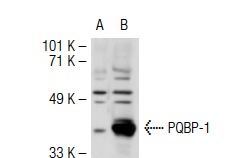
Western blot analysis of PQBP-1 expression in non-transfected: (A) and mouse PQBP-1 transfected: (B) 293T whole cell lysates.Application
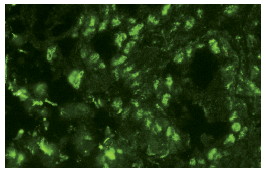
Immunofluorescence staining of normal mouse intestine frozen section showing nuclear staining.| Product Name | PQBP-1 Antibody (FL-265) |
|---|---|
| Antibody Type | Primary Antibodies |
| Antigen Alias | epitope corresponding to amino acids 1-265 representing full length PQBP-1 of human origin |
| Modification Notes | Polyglutamine(Q) tract binding protein-1 (PQBP-1) is a transcription repressor that associates with polyglutamine tract-containing transcription regulators and causative genes for neurodegenerative disorders (1-4). Hepta- and di-amino acid repeat sequences rich in polar residues are essential for PQBP-1 to interact with polyglutamine tract-containing proteins (i.e. huntingtin, androgen receptor and Brain-2) (1,2,5). PQBP-1 contains a WWP/WW domain that binds proline-rich motifs and a C2 domain that can influence Ca2+-dependent phospholipid signaling (6,7). PQBP-1 localizes to the nucleus and is present in neurons throughout the brain, with abundant levels in hippocampus, cerebellar cortex and olfactory bulb (1,3). The human PQBP-1 gene maps to chromosome Xp11.23 (5,8). |
| Clonality | Polyclonal |
|---|---|
| Isotype | IgG |
| Host Species | Rabbit |
| Tested Applications | WBIPIFELISAGSChIP |
| recommended for detection of PQBP-1 of mouse, rat and human origin by WB, IP, IF and ELISA also reactive with additional species, including equine, canine, bovine and porcine: |
|
| Species Reactivity | HumanMouseRat |
| Concentration | 1mg/ml |
| Purification | Affinity purified |
| Alternative Names | epitope corresponding to amino acids 1-265 representing full length PQBP-1 of human origin |
|---|---|
| Tissue Specificity | epitope corresponding to amino acids 1-265 representing full length PQBP-1 of human origin |
| Entrez Gene | 10084 |
|---|
Application
Western blot analysis of PQBP-1 expression in non-transfected: (A) and mouse PQBP-1 transfected: (B) 293T whole cell lysates.
Application
Immunofluorescence staining of normal mouse intestine frozen section showing nuclear staining.| Application Notes | recommended for detection of PQBP-1 of mouse, rat and human origin by WB, IP, IF and ELISA also reactive with additional species, including equine, canine, bovine and porcine: |
|---|
| Form | Liquid |
|---|---|
| Storage Instructions | For short-term storage, store at 4° C. For long-term storage, aliquot and store at -20ºC or below. Avoid multiple freeze-thaw cycles. |
| Storage Buffer | phosphate buffered saline , pH 7.4, 150mM NaCl, 0.02% sodium azide and 50% glycerol. |


