Application
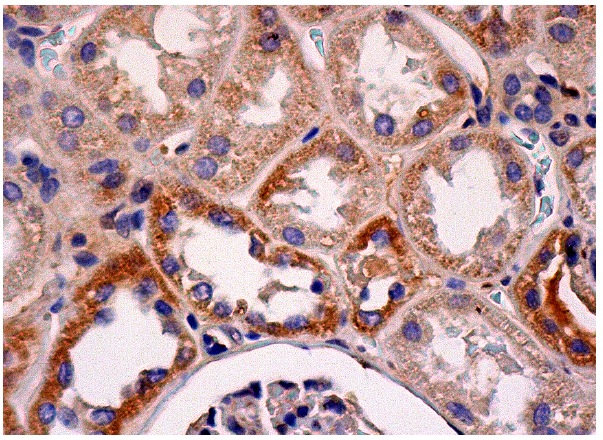
Immunoperoxidase staining of formalin fixed, paraffin-embedded human kidney tissue showing cytoplasmic staining of cells in tubules.| Product Name | HtrA Antibody (H-95) |
|---|---|
| Antibody Type | Primary Antibodies |
| Antigen Alias | epitope corresponding to amino acids 386-480 mapping at the C-terminus of HtrA of human origin |
| Modification Notes | The human homolog of the E. Coli HtrA gene product HtrA is identified in osteoarthritic cartilage and is repressed in SV40-transformed fibroblast. The gene encoding HtrA is highly conserved among mammalian species and belongs to the serine protease family. The HtrA protein contains an IGF-binding domain and exhibits endoproteolytic activity, including autocatalytic cleavage. HtrA is a secreted protein that is expressed in heterologous systems. HtrA plays a role in the degradation of denatured proteins and cell growth regulation. Human HtrA2 (also designated Omi) is a novel member of the HtrA serine protease family and is highly homologous to HtrA (also known as L56 and HtrA1). HtrA2 is a ubiquitously expressed nuclear protease that is capable of autoproteolysis. The HtrA2 protein exists as two polypeptides and as an alternatively spliced form called D-Omi, which is predominately expressed in the kidney, colon and thyroid. Due to a modified PDZ domain, D-Omi does not interact with the known partner of HtrA2, the Mxi2 protein. Like HtrA, HtrA2 is involved in the degradation of aberrantly folded proteins during conditions of cellular stress, suggesting that it may possess a chaperone-like role under normal conditions. |
| Clonality | Polyclonal |
|---|---|
| Isotype | IgG |
| Host Species | Rabbit |
| Tested Applications | WBIPIFIHCELISA |
| recommended for detection of HtrA of mouse, rat and human origin by WB, IP, IF, IHC(P) and ELISA also reactive with additional species, including equine, canine, bovine and porcine: |
|
| Species Reactivity | HumanMouseRat |
| Concentration | 1mg/ml |
| Purification | Affinity purified |
| Alternative Names | epitope corresponding to amino acids 386-480 mapping at the C-terminus of HtrA of human origin |
|---|---|
| Tissue Specificity | epitope corresponding to amino acids 386-480 mapping at the C-terminus of HtrA of human origin |
| Entrez Gene | 5654 |
|---|
Application
Immunoperoxidase staining of formalin fixed, paraffin-embedded human kidney tissue showing cytoplasmic staining of cells in tubules.| Application Notes | recommended for detection of HtrA of mouse, rat and human origin by WB, IP, IF, IHC(P) and ELISA also reactive with additional species, including equine, canine, bovine and porcine: |
|---|
| Form | Liquid |
|---|---|
| Storage Instructions | For short-term storage, store at 4° C. For long-term storage, aliquot and store at -20ºC or below. Avoid multiple freeze-thaw cycles. |
| Storage Buffer | phosphate buffered saline , pH 7.4, 150mM NaCl, 0.02% sodium azide and 50% glycerol. |


