Application
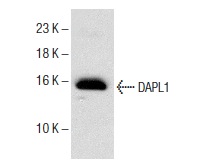
Western blot analysis of DAPL1 expression in MIA PaCa-2 whole cell lysate.| Product Name | DAPL1 Antibody (N-13) |
|---|---|
| Antibody Type | Primary Antibodies |
| Antigen Alias | epitope mapping at the N-terminus of DAPL1 of human origin |
| Modification Notes | In contrast to growth factors which promote cell proliferation, FAS ligand (FAS-L) and the tumor necrosis factors (TNFs) rapidly induce apoptosis. Cellular response to FAS-L and TNF is mediated by structurally related receptors containing a conserved cytoplasmic region called the “death domain”. DAP-1 (Death associated protein-1) is a basic, proline-rich protein expressed in gamma interferon (IFN-gamma)-induced HeLa cells. DAP-1 is a member of the ubiquitin homology (UbH) family which also includes SUMO-1. DAP-1 interacts with the death domain of TNF-R1 and can trigger programmed cell death in a variety of cell lines, as well as suppress NF-kB/Rel activity. DAPL1 (Death-associated protein-like 1), also known as EEDA (Early epithelial differentiation-associated protein), is a 107 amino acid protein that is expressed in hair follicles and is thought to function in a similar manner to DAP-1, possibly participating in the early stages of epithelial differentiation and/or apoptosis. |
| Clonality | Polyclonal |
|---|---|
| Isotype | IgG |
| Host Species | Rabbit |
| Tested Applications | WBIPIFELISA |
| recommended for detection of DAPL1 of human origin by WB, IP, IF and ELISA non cross-reactive with other DAP family members: |
|
| Species Reactivity | HumanMouseRat |
| Concentration | 1mg/ml |
| Purification | Affinity purified |
| Alternative Names | epitope mapping at the N-terminus of DAPL1 of human origin |
|---|---|
| Tissue Specificity | epitope mapping at the N-terminus of DAPL1 of human origin |
| Entrez Gene | 92196 |
|---|
Application
Western blot analysis of DAPL1 expression in MIA PaCa-2 whole cell lysate.| Application Notes | recommended for detection of DAPL1 of human origin by WB, IP, IF and ELISA non cross-reactive with other DAP family members: |
|---|
| Form | Liquid |
|---|---|
| Storage Instructions | For short-term storage, store at 4° C. For long-term storage, aliquot and store at -20ºC or below. Avoid multiple freeze-thaw cycles. |
| Storage Buffer | phosphate buffered saline , pH 7.4, 150mM NaCl, 0.02% sodium azide and 50% glycerol. |


