Application
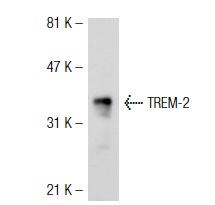
Western blot analysis of TREM-2 expression in mouse brain tissue extract.| Product Name | TREM-2 Antibody (M-227) |
|---|---|
| Antibody Type | Primary Antibodies |
| Antigen Alias | epitope corresponding to amino acids 1-227 representing full length TREM-2 of mouse origin |
| Modification Notes | Polycystic lipomembranous osteodysplasia with sclerosing leukoencephalopathy (PLOSL), known as "Nasu-Hakola disease," is a recessively inherited disease where individuals display early-onset progressive dementia and bone cysts, which leads to death (1,2). Mutations in TYROBP (DAP12), which codes for a membrane receptor component in natural-killer and myeloid cells and mutations in triggering receptor expressed on myeloid cells-2 (TREM-2), correlate well to the pathology of PLOSL (2,3). TREM-2 is a cell surface receptor on human monocyte-derived dendritic cells that forms a receptor signaling complex with DAP12 and triggers activation of the immune response in macrophages and dendritic cells (DC) (2–4). The TREM-2/DAP12 complex is a molecular promoter of upregulation of CC chemokine receptor 7, partial DC maturation, and DC survival through activation of protein tyrosine kinases and extracellular signal-regulated kinase (3,4). The human chronic inflammatory TREM-2 gene maps to chromosome 6p21.1 and encodes a 230 amino acid protein (5). |
| Clonality | Polyclonal |
|---|---|
| Isotype | IgG |
| Host Species | Rabbit |
| Tested Applications | WBIPIFELISA |
| recommended for detection of TREM-2 isoforms 1 and 2 of mouse and rat origin by WB, IP, IF and ELISA: |
|
| Species Reactivity | HumanMouseRat |
| Concentration | 1mg/ml |
| Purification | Affinity purified |
| Alternative Names | epitope corresponding to amino acids 1-227 representing full length TREM-2 of mouse origin |
|---|---|
| Tissue Specificity | epitope corresponding to amino acids 1-227 representing full length TREM-2 of mouse origin |
| Entrez Gene | 83433 |
|---|
Application
Western blot analysis of TREM-2 expression in mouse brain tissue extract.| Application Notes | recommended for detection of TREM-2 isoforms 1 and 2 of mouse and rat origin by WB, IP, IF and ELISA: |
|---|
| Form | Liquid |
|---|---|
| Storage Instructions | For short-term storage, store at 4° C. For long-term storage, aliquot and store at -20ºC or below. Avoid multiple freeze-thaw cycles. |
| Storage Buffer | phosphate buffered saline , pH 7.4, 150mM NaCl, 0.02% sodium azide and 50% glycerol. |


