Application
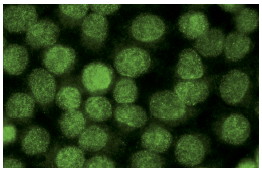
Immunofluorescence staining of methanol-fixed HeLa cells showing nuclear localization.| Product Name | TIF1α Antibody (H-190) |
|---|---|
| Antibody Type | Primary Antibodies |
| Antigen Alias | epitope corresponding to amino acids 631-820 mapping within an internal region of TIF1α of human origin |
| Modification Notes | TIF1a mediates transcriptional events by interactions with the AF2 region of several nuclear receptors, such as the estrogen, retinoic acid and vitamin D3 receptors. TIF1a localizes to nuclear bodies and is thought to associate with chromatin and heterochromatin-associated factors. TIF1a is a member of the tripartite motif (TRIM) family. The TRIM motif includes three zinc-binding domains (RING, B-box type 1 and B-box type 2) and a coiled-coil region. The TIF1a gene, which maps to human chromosome 7q34, encodes two alternatively spliced transcripts. However, the full length nature of one variant has not been determined. A TIF1a homolog (designated bonus) has been identified in Drosophila and is associated with several genes that are implicated in the ecdysone pathway, a nuclear hormone receptor pathway required throughout Drosophila development, suggesting a conserved functional role for the protein throughout the course of evolution. |
| Clonality | Polyclonal |
|---|---|
| Isotype | IgG |
| Host Species | Rabbit |
| Tested Applications | WBIPIFELISAGSChIP |
| recommended for detection of TIF1α long and short isoforms of mouse, rat and human origin by WB, IP, IF and ELISA also reactive with additional species, including equine, canine and bovine: |
|
| Species Reactivity | HumanMouseRat |
| Concentration | 1mg/ml |
| Purification | Affinity purified |
| Alternative Names | epitope corresponding to amino acids 631-820 mapping within an internal region of TIF1&alpha of human origin |
|---|---|
| Tissue Specificity | epitope corresponding to amino acids 631-820 mapping within an internal region of TIF1α of human origin |
| Entrez Gene | 8805 |
|---|
Application
Immunofluorescence staining of methanol-fixed HeLa cells showing nuclear localization.| Application Notes | recommended for detection of TIF1α long and short isoforms of mouse, rat and human origin by WB, IP, IF and ELISA also reactive with additional species, including equine, canine and bovine: |
|---|
| Form | Liquid |
|---|---|
| Storage Instructions | For short-term storage, store at 4° C. For long-term storage, aliquot and store at -20ºC or below. Avoid multiple freeze-thaw cycles. |
| Storage Buffer | phosphate buffered saline , pH 7.4, 150mM NaCl, 0.02% sodium azide and 50% glycerol. |


