Application
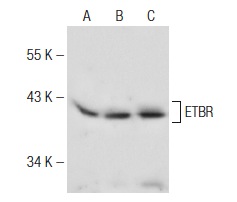
Western blot analysis of ETBR expression in MH-S (A), AMJ2-C8 (B) and EOC 20 (C) whole cell lysates.| Product Name | ETBR Antibody (M-74) |
|---|---|
| Antibody Type | Primary Antibodies |
| Antigen Alias | epitope corresponding to amino acids 27-100 mapping within an N-terminal extracellular domain of ETBR of mouse origin |
| Modification Notes | Endothelin receptor B (ETBR), also known as EDNRB, ETB, ETRB, HSCR and HSCR2, is a member of the guanine-binding, regulatory protein-coupled receptor family. Three isoforms of ETBR exist called isoform 1, isoform 2 and ∂ 3. ETBR is involved in the regulation of sodium excretion and glomular filtration rate (GFR). ETBR plays a role in the normal development of the neural crest-derived cell lineages, epidermal melanocytes and enteric neurons. ETBR is expressed in lung, kidney, placenta, skeletal muscle and stem villi vessels. Both of the ET receptors, ETAR and ETBR, are activated by ET1, which results in inhibition of active lens sodium-potassium transport. Activation of the ET receptors also causes an increase in cytoplasmic calcium concentration in cultured lens epithelial cells. ETBR deficiency causes early onset dysfunction of the kidney, characterized by reduced sodium excretion, decreased GFR and slightly elevated blood pressure. Mutations in the gene encoding ETBR produce congenital aganglionic megacolon and pigment abnormalities. The multigenic disorder, Hirschsprung’s disease Type 2, is also due to a mutation in the ETBR gene. |
| Clonality | Polyclonal |
|---|---|
| Isotype | IgG |
| Host Species | Rabbit |
| Tested Applications | WBIPIFELISA |
| recommended for detection of ETBR of mouse and rat origin by WB, IP, IF and ELISA: |
|
| Species Reactivity | HumanMouseRat |
| Concentration | 1mg/ml |
| Purification | Affinity purified |
| Alternative Names | epitope corresponding to amino acids 27-100 mapping within an N-terminal extracellular domain of ETBR of mouse origin |
|---|---|
| Tissue Specificity | epitope corresponding to amino acids 27-100 mapping within an N-terminal extracellular domain of ETBR of mouse origin |
| Entrez Gene | 13618 |
|---|
Application
Western blot analysis of ETBR expression in MH-S (A), AMJ2-C8 (B) and EOC 20 (C) whole cell lysates.| Application Notes | recommended for detection of ETBR of mouse and rat origin by WB, IP, IF and ELISA: |
|---|
| Form | Liquid |
|---|---|
| Storage Instructions | For short-term storage, store at 4° C. For long-term storage, aliquot and store at -20ºC or below. Avoid multiple freeze-thaw cycles. |
| Storage Buffer | phosphate buffered saline , pH 7.4, 150mM NaCl, 0.02% sodium azide and 50% glycerol. |


