Application
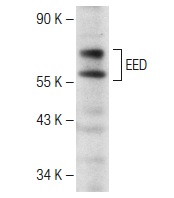
Western blot analysis of EED expression in K-562 whole cell lysate.| Product Name | EED Antibody (H-300) |
|---|---|
| Antibody Type | Primary Antibodies |
| Antigen Alias | epitope corresponding to amino acids 142-441 mapping at the C-terminus of EED of human origin |
| Modification Notes | The transcriptional repressing Polycomb-group (PcG) and transcriptional activating trithorax-group (trxG) genes of Drosophila are part of a cellular memory system responsible for the stable inheritance of gene activity. PcG proteins assemble into multimeric protein complexes, which are involved in maintaining the transcriptional repressive state of genes over successive cell generations. EED (embryonic ectoderm development) is the human homolog of Eed, a murine PcG gene homologous to the Drosophila homeotic gene, extra sex combs. The human EED protein is 99. 5% identical to the mouse EED protein and contains seven WD repeats, which are involved in protein-protein interactions. There are two human EED transcripts that contain a putative 407-nucleotide-long intron and give rise to two HEED protein isoforms, 535 and 494 amino acids in length. EED interacts in a highly specific manner, both in vitro and in vivo, with histone deacetylase (HDAC) proteins. |
| Clonality | Polyclonal |
|---|---|
| Isotype | IgG |
| Host Species | Rabbit |
| Tested Applications | WBIPIFELISA |
| recommended for detection of EED of mouse, rat and human origin by WB, IP, IF and ELISA also reactive with additional species, including equine, canine, bovine, porcine and avian: |
|
| Species Reactivity | HumanMouseRat |
| Concentration | 1mg/ml |
| Purification | Affinity purified |
| Alternative Names | epitope corresponding to amino acids 142-441 mapping at the C-terminus of EED of human origin |
|---|---|
| Tissue Specificity | epitope corresponding to amino acids 142-441 mapping at the C-terminus of EED of human origin |
| Entrez Gene | 8726 |
|---|
Application
Western blot analysis of EED expression in K-562 whole cell lysate.| Application Notes | recommended for detection of EED of mouse, rat and human origin by WB, IP, IF and ELISA also reactive with additional species, including equine, canine, bovine, porcine and avian: |
|---|
| Form | Liquid |
|---|---|
| Storage Instructions | For short-term storage, store at 4° C. For long-term storage, aliquot and store at -20ºC or below. Avoid multiple freeze-thaw cycles. |
| Storage Buffer | phosphate buffered saline , pH 7.4, 150mM NaCl, 0.02% sodium azide and 50% glycerol. |


