Application
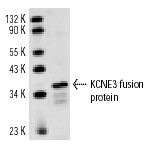
Western blot analysis of human recombinant KCNE3 fusion protein.| Product Name | KCNE3 Antibody (H-80) |
|---|---|
| Antibody Type | Primary Antibodies |
| Antigen Alias | epitope corresponding to amino acids 1-80 mapping at the N-terminus of KCNE3 of human origin |
| Modification Notes | Voltage-gated K+ channels in the plasma membrane control the repolarization and the frequency of action potentials in neurons, muscles, and other excitable cells. KCNE3 (potassium voltage-gated channel, Isk-related family, member 3), also known as HYPP, potassium channel subunit beta MiRP2 or HOKPP, is a 103 amino acid single-pass type I membrane protein belonging to the potassium channel KCNE family. Expressed predominantly in kidney, KCNE3 is also found at moderate levels in small intestine and associates with a voltage-gated potassium channel complex to regulate stability and gating kinetics. The gene encoding KCNE3 maps to human chromosome 11q13.4; defects in which are the cause of an autosomal dominant disorder known as periodic paralysis hypokalemic (or HOKPP), a muscular disorder known as thyrotoxic periodic paralysis type 1 (TTPP1) and Brugada syndrome type 6 (BRS6). |
| Clonality | Polyclonal |
|---|---|
| Isotype | IgG |
| Host Species | Rabbit |
| Tested Applications | WBIPIFELISA |
| recommended for detection of KCNE3 of mouse, rat and human origin by WB, IP, IF and ELISA also reactive with additional species, including equine, canine, bovine and porcine: |
|
| Species Reactivity | HumanMouseRat |
| Concentration | 1mg/ml |
| Purification | Affinity purified |
| Alternative Names | epitope corresponding to amino acids 1-80 mapping at the N-terminus of KCNE3 of human origin |
|---|---|
| Tissue Specificity | epitope corresponding to amino acids 1-80 mapping at the N-terminus of KCNE3 of human origin |
| Entrez Gene | 10008 |
|---|
Application
Western blot analysis of human recombinant KCNE3 fusion protein.| Application Notes | recommended for detection of KCNE3 of mouse, rat and human origin by WB, IP, IF and ELISA also reactive with additional species, including equine, canine, bovine and porcine: |
|---|
| Form | Liquid |
|---|---|
| Storage Instructions | For short-term storage, store at 4° C. For long-term storage, aliquot and store at -20ºC or below. Avoid multiple freeze-thaw cycles. |
| Storage Buffer | phosphate buffered saline , pH 7.4, 150mM NaCl, 0.02% sodium azide and 50% glycerol. |


