Application
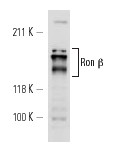
Western blot analysis of Ron β expression in SW480 whole cell lysate.Application
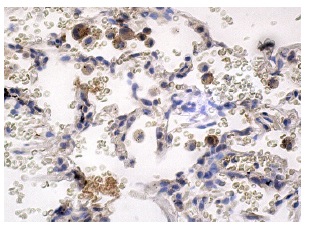
Immunoperoxidase staining of formalin fixed, paraffin-embedded human lung tissue showing cytoplasmic staining of macrophages.| Product Name | Ron β Antibody (H-160) |
|---|---|
| Antibody Type | Primary Antibodies |
| Antigen Alias | epitope corresponding to amino acids 531-690 of the Ron precursor of human origin |
| Modification Notes | Receptor protein tyrosine kinases (PTKs) have been classified into different subclasses on the basis of sequence similarity and distinct structural characteristics. The c-Met encoded receptor represents the initial member of one class of receptors characterized by a heterodimeric structure and a cysteine-rich extracellular domain. Ron, also designated macrophage-stimulating protein receptor (MSP receptor), p185-Ron, CD136 antigen or PTK8 represents a second member of this receptor class. The intracellular PTK domains of Ron and Met are highly similar (63% sequence identity) while the extracellular domains are less related (25% sequence identity) and both are rich in cysteine residues. Mature Ron receptor is comprised of a disulfide-linked heterodimer formed from an alpha chain (Ron å) and a beta chain (Ron ∫). Proteolytic processing results in the separation of the N-terminal Ron å and C-terminal Ron ∫ subunits. |
| Clonality | Polyclonal |
|---|---|
| Isotype | IgG |
| Host Species | Rabbit |
| Tested Applications | WBIPIFIHCELISA |
| recommended for detection of Ron β of mouse, rat and human origin by WB, IP, IF, IHC(P) and ELISA: |
|
| Species Reactivity | HumanMouseRat |
| Concentration | 1mg/ml |
| Purification | Affinity purified |
| Alternative Names | epitope corresponding to amino acids 531-690 of the Ron precursor of human origin |
|---|---|
| Tissue Specificity | epitope corresponding to amino acids 531-690 of the Ron precursor of human origin |
| Entrez Gene | 4486 |
|---|
Application
Western blot analysis of Ron β expression in SW480 whole cell lysate.
Application
Immunoperoxidase staining of formalin fixed, paraffin-embedded human lung tissue showing cytoplasmic staining of macrophages.| Application Notes | recommended for detection of Ron β of mouse, rat and human origin by WB, IP, IF, IHC(P) and ELISA: |
|---|
| Form | Liquid |
|---|---|
| Storage Instructions | For short-term storage, store at 4° C. For long-term storage, aliquot and store at -20ºC or below. Avoid multiple freeze-thaw cycles. |
| Storage Buffer | phosphate buffered saline , pH 7.4, 150mM NaCl, 0.02% sodium azide and 50% glycerol. |


