Application
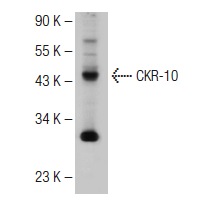
Western blot analysis of CKR-10 expression in HeLa whole cell lysate.| Product Name | CKR-10 Antibody (H-150) |
|---|---|
| Antibody Type | Primary Antibodies |
| Antigen Alias | epitope corresponding to amino acids 141-290 mapping within an internal region of CKR-10 of human origin |
| Modification Notes | C-C or b chemokine family members are characterized by a pair of adjacent cysteine residues and serve as potent chemoattractants and activators of monocytes and T cells (1). C-C chemokine receptor family members include CKR-1, CKR-2A, CKR-2B, CKR-3, CKR-4, CKR-5, CKR-6, CKR-7, CKR-8, CKR-9, CKR-10 and the Duffy blood group antigen (2,3). Each of these receptors are G protein coupled, seven pass transmembrane domain proteins, whose major physiological role is to function in the chemotaxis of T cells and phagocytic cells to areas of inflammation (3-5). CKR-10 (also designated CCR10 and GPR2) is the specific receptor for CCL27 (also designated CTACK, ESkine, ALP or ILC) and CCL28 (6,7). The gene encoding CKR-10 has been mapped to human chromosome 7q21 and is highly expressed in testis, small intestine, fetal lung and fetal kidney (6,8). CKR-10 also has weaker expression in many adult tissues, including melanocytes, dermal fibroblasts and dermal microvascular endothelial cells, which suggest a role for CKR-10 in skin homeostasis and inflammatory response (6). |
| Clonality | Polyclonal |
|---|---|
| Isotype | IgG |
| Host Species | Rabbit |
| Tested Applications | WBIPIFELISA |
| recommended for detection of CKR-10 of mouse, rat and human origin by WB, IP, IF and ELISA also reactive with additional species, including equine, canine, bovine and porcine: |
|
| Species Reactivity | HumanMouseRat |
| Concentration | 1mg/ml |
| Purification | Affinity purified |
| Alternative Names | epitope corresponding to amino acids 141-290 mapping within an internal region of CKR-10 of human origin |
|---|---|
| Tissue Specificity | epitope corresponding to amino acids 141-290 mapping within an internal region of CKR-10 of human origin |
| Entrez Gene | 2826 |
|---|
Application
Western blot analysis of CKR-10 expression in HeLa whole cell lysate.| Application Notes | recommended for detection of CKR-10 of mouse, rat and human origin by WB, IP, IF and ELISA also reactive with additional species, including equine, canine, bovine and porcine: |
|---|
| Form | Liquid |
|---|---|
| Storage Instructions | For short-term storage, store at 4° C. For long-term storage, aliquot and store at -20ºC or below. Avoid multiple freeze-thaw cycles. |
| Storage Buffer | phosphate buffered saline , pH 7.4, 150mM NaCl, 0.02% sodium azide and 50% glycerol. |


