Application
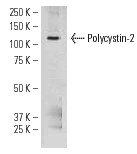
Western blot analysis of Polycystin-2 expression in MIA PaCa-2 whole cell lysate.Application
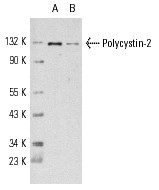
Western blot analysis of Polycystin-2 expression in Caki-1 (A) and KNRK (B) whole cell lysates.| Product Name | Polycystin-2 Antibody (H-280) |
|---|---|
| Antibody Type | Primary Antibodies |
| Antigen Alias | epitope corresponding to amino acids 689-968 of Polycystin-2 of human origin |
| Modification Notes | Autosomal dominant polycystic kidney disease (ADPKD) is characterized by the formation of cysts in kidney tubules as well as in liver and pancreas tissues. Cells within these cysts display abnormalities in proliferation and polarity. Polycystin-2 (PKD2), an integral membrane glycoprotein, is mutated in approximately 15% of patients with ADPKD. Polycystin-2 is expressed in medullary collecting ducts, cortical collecting ducts and distal convoluted tubules of kidney. It associates with Hax-1 and may be involved in cell-matrix interactions. Polycystin-1 and Polycystin-2 display significant homology within their transmembrane region and are thought to interact in order to enhance AP-1 expression, which regulates cell proliferation, differentiation and apoptosis. These findings suggest that mutations in Polycystin-2 may facilitate the development of renal tubular cysts. |
| Clonality | Polyclonal |
|---|---|
| Isotype | IgG |
| Host Species | Rabbit |
| Tested Applications | WBIPIFELISA |
| recommended for detection of Polycystin-2 of mouse, rat and human origin by WB, IP, IF and ELISA also reactive with additional species, including canine, bovine and porcine: |
|
| Species Reactivity | HumanMouseRat |
| Concentration | 1mg/ml |
| Purification | Affinity purified |
| Alternative Names | epitope corresponding to amino acids 689-968 of Polycystin-2 of human origin |
|---|---|
| Tissue Specificity | epitope corresponding to amino acids 689-968 of Polycystin-2 of human origin |
| Entrez Gene | 5311 |
|---|
Application
Western blot analysis of Polycystin-2 expression in MIA PaCa-2 whole cell lysate.
Application
Western blot analysis of Polycystin-2 expression in Caki-1 (A) and KNRK (B) whole cell lysates.| Application Notes | recommended for detection of Polycystin-2 of mouse, rat and human origin by WB, IP, IF and ELISA also reactive with additional species, including canine, bovine and porcine: |
|---|
| Form | Liquid |
|---|---|
| Storage Instructions | For short-term storage, store at 4° C. For long-term storage, aliquot and store at -20ºC or below. Avoid multiple freeze-thaw cycles. |
| Storage Buffer | phosphate buffered saline , pH 7.4, 150mM NaCl, 0.02% sodium azide and 50% glycerol. |


