Application
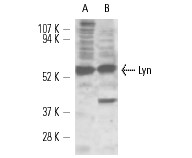
Western blot analysis of Lyn expression in Ramos (A) and HL-60 (B) whole cell lysates.| Product Name | Lyn Antibody (H-70) |
|---|---|
| Antibody Type | Primary Antibodies |
| Antigen Alias | epitope corresponding to amino acids 1-70 mapping at the N-terminus of Lyn of human origin |
| Modification Notes | Src is the human homolog of the v-src gene of the Rous sarcoma virus, also known as avian sarcoma virus or ASV. Src is the first proto-oncogenic non-receptor tyrosine kinase characterized in human. By virtue of common structural motifs, the Src family is composed of nine members in vertebrates, including Src, Yes, Fgr, Frk, Fyn, Lyn, Hck, Lck and Blk. Src-family kinases transduce signals that are involved in the control of a variety of cellular processes, including proliferation, differentiation, motility, and adhesion. Src-family kinases contain an amino terminal cell membrane anchor followed by an SH3 domain and an SH2 domain involved in modular association and activation, respectively. Src-family kinases are normally maintained in an inactive state and can be activated transiently during cellular events such as mitosis. The human Lyn gene maps to chromosome 8q12 and encodes a 505 amino acid protein. Hematopoietic tissues predominantly express Lyn, which influences normal immunoglobulin production and regulation. |
| Clonality | Polyclonal |
|---|---|
| Isotype | IgG |
| Host Species | Rabbit |
| Tested Applications | WBIPIFELISA |
| recommended for detection of Lyn of mouse, rat and human origin by WB, IP, IF and ELISA also reactive with additional species, including equine, canine and bovine: |
|
| Species Reactivity | HumanMouseRat |
| Concentration | 1mg/ml |
| Purification | Affinity purified |
| Alternative Names | epitope corresponding to amino acids 1-70 mapping at the N-terminus of Lyn of human origin |
|---|---|
| Tissue Specificity | epitope corresponding to amino acids 1-70 mapping at the N-terminus of Lyn of human origin |
| Entrez Gene | 4067 |
|---|
Application
Western blot analysis of Lyn expression in Ramos (A) and HL-60 (B) whole cell lysates.| Application Notes | recommended for detection of Lyn of mouse, rat and human origin by WB, IP, IF and ELISA also reactive with additional species, including equine, canine and bovine: |
|---|
| Form | Liquid |
|---|---|
| Storage Instructions | For short-term storage, store at 4° C. For long-term storage, aliquot and store at -20ºC or below. Avoid multiple freeze-thaw cycles. |
| Storage Buffer | phosphate buffered saline , pH 7.4, 150mM NaCl, 0.02% sodium azide and 50% glycerol. |


