Application
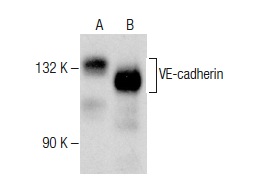
Western blot analysis of VE-cadherin expression in human lung (A) and mouse placenta (B) tissue extracts.| Product Name | VE-cadherin Antibody (H-72) |
|---|---|
| Antibody Type | Primary Antibodies |
| Antigen Alias | epitope corresponding to amino acids 651-722 mapping within a C-terminal cytoplasmic domain of VE-cadherin of human origin |
| Conjugation | Agarose |
| Modification | Acetylated |
| Modification Notes | The cadherins are a family of Ca2+-dependent adhesion molecules that function to mediate cell-cell binding critical to the maintenance of tissue structure and morphogenesis. Cadherins each contain a large extracellular domain at the amino-terminus, which is characterized by a series of five homologous repeats, the most distal of which is thought to be responsible for binding specificity. The relatively short carboxy-terminal, intracellular domain interacts with a variety of cytoplasmic proteins, including ∫-catenin, to regulate cadherin function. VE-cadherin (for vascular endothelial cadherin, also designated cadherin-5) is localized at intercellular junctions of endothelial cells, where it is thought to play a role in the cohesion and organization of intercellular junctions. |
| Clonality | Polyclonal |
|---|---|
| Isotype | IgG |
| Host Species | Rabbit |
| Tested Applications | ELISAIFIPWB |
| recommended for detection of VE-cadherin of mouse, rat and human origin by WB, IP, IF and ELISA : WB:1:100~1:500 IP:1:20~1:100 IF:1:20~1:100 |
|
| Species Reactivity | HumanMouseRat |
| Predicted Reactivity | equine, bovine and porcine |
| Concentration | 1mg/ml |
| Purification | Affinity purified |
| Alternative Names | epitope corresponding to amino acids 651-722 mapping within a C-terminal cytoplasmic domain of VE-cadherin of human origin |
|---|---|
| Molecular Weight(MW) | 88 kDa |
| Tissue Specificity | epitope corresponding to amino acids 651-722 mapping within a C-terminal cytoplasmic domain of VE-cadherin of human origin |
| Entrez Gene | 1003 |
|---|
Application
Western blot analysis of VE-cadherin expression in human lung (A) and mouse placenta (B) tissue extracts.| Application Notes | recommended for detection of VE-cadherin of mouse, rat and human origin by WB, IP, IF and ELISA : WB:1:100~1:500 IP:1:20~1:100 IF:1:20~1:100 |
|---|
| Form | Liquid |
|---|---|
| Storage Instructions | For short-term storage, store at 4° C. For long-term storage, aliquot and store at -20ºC or below. Avoid multiple freeze-thaw cycles. |
| Storage Buffer | phosphate buffered saline , pH 7.4, 150mM NaCl, 0.02% sodium azide and 50% glycerol. |


